As a holistic nutritionist for the past 10 years, I’ve had some pretty cool gigs.
I launched and ran my own private nutrition practice.
I’ve taught cooking classes to kids and adults.
I’ve given lectures on nutrition.
I’ve developed over 200 recipes for various companies.
I’ve interviewed super-smart health experts and translated those conversations into articles, video scripts, cartoons, and infographics.
I’ve helped friends and family make better health choices and improved my own health tremendously.
And to think…
Save $200 on the industry's top nutrition certification
Help people improve their health and fitness—while making a great full-time or part-time living doing what you love.

I used to hate my job.
Twelve years ago, I worked a pretty standard office job.
I loved my officemates, but the work was unstimulating and didn’t connect to my values. I also felt totally replaceable.
My job dissatisfaction also seemed to mutate into physical symptoms: I was achy, lethargic, pimply, and bloated.
Because of this general malaise, I was constantly Googling health topics:
Always bloated why
Sitting but no energy
Does stress cause acne
Etcetera.
Everything I learned fascinated me.
And whenever friends and family brought up nutrition or food, I was rapt. I always wanted to know what people ate, how they ate it, and how they felt.
One day, when a girlfriend mentioned her bowel habits—and I wanted to know all the details—I knew I was getting really weird.
But like, weird in a non-creepy way.
Weird in a way that maybe I could harness for good.
Then, like a little sunlit path splitting off from the road-to-doom, I had a vision:
I wanted to become a health coach.
I wanted to help people eat healthier and feel better. And yes, poop better too.
(If you’re interested in coaching, you might like our FREE newsletter, The Smartest Coach in the Room. Every week you’ll get helpful takeaways on the hottest nutrition and health topics and the world’s most effective coaching techniques.)
++++
What is a holistic health coach, exactly?
The word “holistic” might make you think of homemade granola, tie-dyed socks, and herbal remedies.
But really, “holistic” just means “comprehensive.”
A holistic health coach helps people achieve health goals by using a “whole picture” approach.
This approach acknowledges that physical health is deeply intertwined with every facet of a person’s life: relationships, mindset, spirituality, and more.
And heads up! Terms and titles can get confusing, so let’s clear it up here:
“Holistic health coaching” is more of an umbrella term rather than a specific, recognized designation.
It describes a style of health coaching that has a holistic perspective.
All holistic-style coaching certifications are going to include nutrition. Similarly, “holistic nutrition coaching” certifications aren’t really different from “holistic health coaching” certifications.
I went to holistic nutrition school, and my official designation is a Registered Holistic Nutritionist (RHN), but I’m still considered a holistic health coach.
Holistic coaches address the whole person, in the context of their life.
For example, let’s say a 50-year-old woman wants to stop eating junk food and improve her fitness.
Some health professionals may address this in a very clearly-defined, isolated way: Eat better and exercise more. (They’re not wrong!)
A holistic health coach might do things a little differently. They might wonder about the reasons the client is eating junk food in the first place, and if there are any barriers to exercising more:
- Is she lonely and food is her only comfort?
- Do her grocery shopping and food prep skills need some work?
- Is she so busy and overwhelmed that she feels she doesn’t have time to cook or exercise?
- Does she feel so crappy about her body that she’s terrified of setting foot in a gym?
- Are there people in her family who cry every time she tries to introduce a vegetable at the table?
- Is she sleep-deprived and having trouble finding the energy to exercise?
So instead of giving someone a plan that focuses only on diet and/or exercise, a holistic health coach may help a client with their:
- Life skills: food shopping and meal prep; communication with family about health priorities; time-management; mindfulness and self-awareness
- Habits, systems, and behaviors: sleep or bedtime routines; stress-management practices; weekly or daily meal prep routines
- Beliefs: dealing with body image issues; breaking down the “good” food vs. “bad” food dichotomy; addressing negative associations with exercise or “dieting”; digging up meaningful reasons to change
And more.
Why I went holistic.
Through my own experience it was clear:
How you feel isn’t just about what you eat.
My diet had always been pretty healthy. My version of “junk food” was a rice cake topped with peanut butter and honey.
And yet I was anxious, overweight, and tired all the time. I got stomach aches after every meal, and my skin was worse than it had been as a hormonal teen.
Small tweaks in my diet made some difference. But I knew that how I felt also had to do with my sedentary job, the heartbreak I was nursing after a bad breakup, and the sense of purposelessness I felt in my career.
In order to really feel better, I realized I’d have to change a bunch of things—not just my diet.
I also knew that if I wanted to help coach other people to feel better, I’d want to consider more than their diet too.
Interestingly, this is also how Precision Nutrition coaches. But instead of calling it “holistic health coaching,” we call it “coaching for deep health.”
How holistic or “deep health” coaching helps people.
Coaching for deep health (or holistic health coaching, if you prefer), is about looking at a client’s whole life, and asking: What’s really keeping you from feeling deep alignment with your health and fitness?
What’s the problem… behind your problem?
Where do you most need help, right now?
And what are you already good at, that we can build on?
(At PN, we use this chart to “measure” a client’s deep health, and figure out the answers to these questions.)
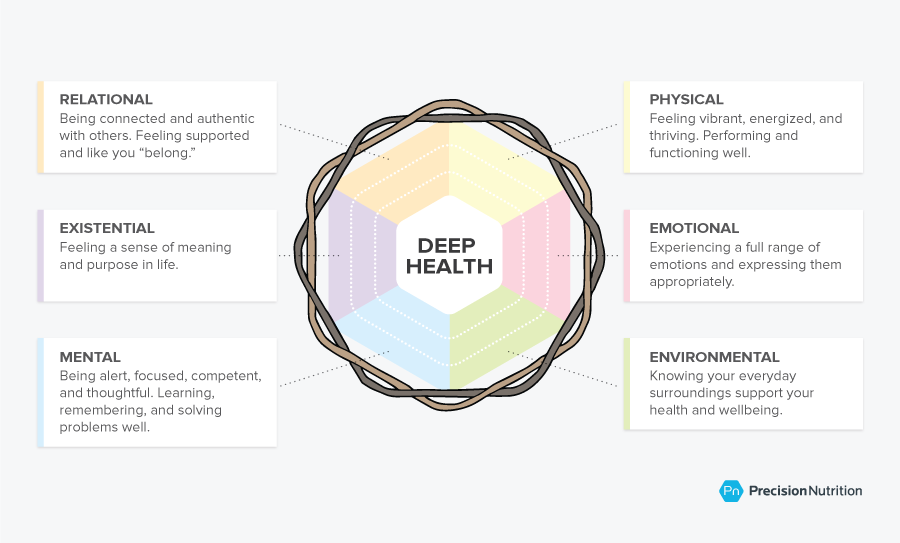
The answers help us decide where you should focus first. It might be nutrition or exercise, but as I said earlier, it could also be your sleep quality, your stress levels, or even your mindset.
Because they’re all connected: Each one can improve the others—and multiply your ability to both make and maintain progress.
We teach “deep health” coaching here at Precision Nutrition, and it’s how you’ll learn to help clients if you become a holistic health coach.
How do you become a holistic health coach?
Once I made up my mind to trade my stable income (with benefits!) for an unknown—but potentially more fulfilling—future, I knew I needed to get certified. I just had to decide where.
Depending on where you live, you’ll find a number of institutions that offer holistic health coaching certifications, either in-person or online.
Picking a school or certification program is a big commitment, and it’s a choice that will affect your future opportunities too.
My advice: Research well and choose strategically.
In my opinion, there are several criteria you’ll want to consider when evaluating your options…
How long will it take to get certified?
Most programs will take between six months to a year of full-time study, or a year to two years of part-time study.
Expect about three to six hours of class and/or lecture time per week, and at least the same amount of time for studying, reading, and assignments.
Because I was working when I got certified, I opted to be a part-time student initially. Eventually, I decided to transition to being a full-time student. I wanted to immerse myself fully in my studies, and I was so ready to leave my aforementioned job. Let someone else keep my swivel chair warm.
How much does it cost to get certified?
Programs vary quite a bit in cost. Some certifications are as low as $800 USD, and others are closer to $7,000 USD.
Many courses include all the materials you need to complete the course work, but others may require you to pay for textbooks and readings out-of-pocket, which can add up to a few hundred dollars on top of tuition.
Think of these costs as an investment.
Do you have a clear sense of the potential return?
You’ll want to think about:
- Will you have to take on any debt to complete a given program?
- What will your income potential be after earning your certification? (More on that in a bit!)
- How long will it take you to recoup the money spent on tuition?
For instance, if you’re planning to run your own business, it can take some time to really get going. So it would be wise to factor this consideration into your financial planning.
What title or designation will you earn?
If you want to be able to call yourself a certain title after getting certified, this is an important detail.
Depending on your school or program, the regulating body you choose to associate with, and your clinical standing and experience, you might be called:
- a Registered Holistic Nutritionist (RHN)
- a Certified Nutritional Practitioner (CNP)
- a Registered Nutritional Therapist (RNT)
- a Certified Health Coach
- an Integrative Health Coach
(This is just a small selection of the options—there are dozens of other holistic titles out there.)
Can you become a holistic health coach through PN?
Not by title.
Here’s the thing:
While titles like “dietician” or “physiotherapist” are regulated, “holistic health coach” is not.
To use the former designations, you have to graduate from an approved college or university that provides standardized curriculums and testing.
But to call yourself a holistic health coach, you don’t actually need any formal education.
Someone who’s read a few nutrition books can call themself a holistic health coach, see clients, and (for better or for worse), run a business.
We really don’t recommend you do that. But some people do it. Which is why it’s always important to check someone’s credentials before you trust what they’re saying, even if they have a cool-sounding title.
The programs we’ve linked to above emphasize a holistic (or whole picture) approach to health coaching, and they’re all regulated. But as you might have noticed, graduates of these programs earn slightly different titles.
All of them provide a great education that teaches you a holistic framework, but you won’t necessarily be certified as a “holistic health coach” when you graduate.
Graduates of PN’s Level 1 Nutrition and Level 1 Sleep, Stress Management, and Recovery Certifications, and our Level 2 Master Health Coaching Certification, will also learn to coach within a holistic framework, but you won’t be called a “holistic health coach.” You’ll be called “PN Certified” or a “PN L2 Master Health Coach.”
What will you learn?
I looooved going back to school.
Perhaps for the first time in my life, I looked around at my peers and felt, “These are my people.”
In my program, we focused on the fundamentals of nutrition: what nutrients are in what foods, and how the body metabolizes them. That’s one thing that most holistic coaching programs will have in common.
But I also learned about various disorders and diseases like diabetes, autoimmune disorders, and cancer. As a holistic health coach, you’re not legally qualified to diagnose or treat diseases, but you’ll still likely learn how they might develop, and what nutritional approaches support goals like balanced blood sugar, weight management, or immune health.
I learned about health modalities such as Ayurveda, Traditional Chinese Medicine, hydrotherapy, and herbal medicine.
We learned to build health using a toolkit of nutritious food, exercise, and lifestyle practices.
When I graduated, I felt I had a ton of information that I could use to help my future clients.
So when choosing a certification program, I’d encourage you to think about what specifically you want to learn.
- Do you only want to learn the nuts and bolts of practical nutrition?
- Do you want in-depth knowledge of biochemistry and physiology?
- Are you interested in learning about the psychology of behavior change?
- How about other modalities, such as herbal medicine or Traditional Chinese Medicine?
Depending on your goals, you may favor a program with a heavier emphasis on science and nutritional theory, or one with an emphasis on the practical application of health behaviors (like eating more vegetables and moving more).
A very personal opinion on what I missed in holistic nutrition school.
My first ever (paying!) client session was… enlightening.
During the intake, I felt I developed a clear understanding of my client’s “problem,” and what I could propose to help.
I shared my recommendations, and then my client said, “Well, I know a lot of that stuff. I just don’t know how to keep doing it.”
‘Oh.’ I thought. ‘Crap.’
As I fumbled through the rest of that appointment, I realized that with all my knowledge of nutrition, body systems, and disease pathology, I actually didn’t know much about helping people change their behavior, especially when they already knew what to do.
Those first years of coaching were really, really hard. I learned painfully, slowly, and awkwardly. My nutrition program hadn’t “let me down,” but I did feel like something was missing.
Years later, when I began a coaching internship with PN and completed the Level 1 and Level 2 certifications, I felt like I found the missing link.
With their emphasis on change psychology, the L1 and especially L2 curriculums taught me not just the “what” of change, but also the “how” of change.
I finally felt like I had a clear method of how to:
- clarify clients’ goals
- come up with the first action steps
- assess progress, and
- continue moving forward, even through setbacks.
I felt more confident as a coach and much less anxious.
My clients got better results, and the whole experience felt so much more rewarding.
I’ll never regret getting certified as a holistic nutritionist, but over the years, I’ve realized that, in practice, I don’t actually use a lot of the deep nutrition knowledge I learned in school.
Because in reality, most people struggle with the basics. Most people improve immensely when they master just a few fundamentals: consistently eating nutrient-dense foods, moving regularly, and sleeping well.
The trickiest (and most interesting) part of coaching is helping people to actually do those habits.
What’s the school or program’s reputation like?
Name recognition isn’t everything, but understanding how a program is regarded in the health and wellness world (especially within the area you’d like to work in) can help you make an informed decision. Some questions you could consider to assess this are:
- Have you heard of the school or program you’re considering before?
- Do you know people who are graduates or people who have been clients of graduates?
- Does the school you’re considering have any “superstar” graduates, whose careers and integrity you admire?
- Are graduates ever featured as experts in reputable publications?
How do graduates rate their experiences?
Relatedly, I strongly recommend talking to graduates of whatever program you’re considering. Most schools have a list of alumni that they can connect you with for this purpose.
Talking to alumni will not only tell you about the experience of being a student, but it will also give you a sense of your options after graduating. During these conversations, you might ask:
- What’s it like to work as a holistic health practitioner?
- What does the process of building a business look like?
- Are there any extra courses they found useful after graduating?
In my experience, the alumni I spoke with were surprisingly candid; I felt clear about the benefits and the shortcomings of the programs I was considering. When it was time to pick a school, I felt I was making an informed choice.
What will your scope of practice be?
You’ll also want to consider what you can legally do with your certification once you graduate.
Are you eligible for insurance coverage? Are your clients?
Can you recommend specific diets or hydration techniques, supplements, or exercise programs?
Programs should tell you upfront what you can, and perhaps more importantly, what you can’t do.
If you really want to practice a certain modality (say, acupuncture) or work with a specific population (say, people with diabetes) make sure in advance that you’re getting a designation that qualifies you to do so.
What do holistic health coaches do?
The short answer: It depends—a lot!
For six years, I ran an in-person nutrition practice out of my home, and also worked part-time at a busy health food store.
At the health food store, I saw a high volume of people, which gave me an immediate connection to health trends and concerns. In my private nutrition practice, I saw fewer people but developed deeper relationships with them, and was able to follow their progress.
Later, because of my education and experience, I was chosen to intern as an assistant coach with PN’s Coaching Program. While I interned, I got my Level 1 and Level 2 certifications and did some writing for the company’s blog and educational materials.
I also had opportunities to speak at community events, represent health food brands, and teach cooking classes.
Today, I’m so grateful for these experiences; my holistic nutrition certification opened a lot of doors for me.
Holistic health coaches can work directly with clients.
If you’re a “people person” and want to work with clients directly, you can do so in a number of different settings:
▶ Home practice: You see clients in a space in your home, or travel to clients’ homes. You can host sessions in-person or virtually.
▶ Private clinic: Many multi-modal clinics want a practitioner devoted to health coaching. This can complement the services of other practitioners at the clinic, like naturopaths, chiropractors, and massage therapists.
▶ Gyms / Yoga studios / Spas: Many of these facilities have in-house nutrition and health coaches.
▶ Retreats: Offering retreats can be a great way to provide intensive group coaching in a supportive setting. Retreats led by holistic health coaches usually offer a combination of lectures or workshops, cooking demos, nutritious meals, and guided exercise.
▶ Retail: Health food stores, supplement stores, and natural beauty stores hire health coaches to educate customers and help them make informed purchases.
▶ Corporations: Increasingly, companies are realizing that employee health is literally good for business, and are implementing employee wellness programs or offering incentives for healthy lifestyle changes. A health coach may be hired for a series of workshops, or may have “office hours” at regular intervals (weekly or bi-weekly) to have one-on-one sessions with employees.
If working with clients isn’t your thing, there are (many) other options.
If you have a passion for health, but the intimacy of working directly with people makes you itchy, there’s still a place for you!
Here are some options for holistic health coaches that aren’t client-facing:
▶ Writer: Whether doing contract work for publications, being a staff writer for an organization, or just blogging for your own personal site, you can communicate your health expertise through articles, video scripts, or even write a book!
▶ Teacher: Online or in-class, you can teach health-related topics to other students looking to get certified, practitioners wanting to upgrade their skills, or just regular folks looking to empower their own health decisions.
▶ Personal chef: If making nutritious meals is your jam, there are tons of time-pressed people looking to scratch cooking off their to-do list without resorting to frozen burritos three meals a day.
▶ Product creator: Some health experts make stuff intended for the mass-market, whether that’s a genius healthy cookie, a protein supplement, or a natural deodorant (that actually works).
▶ Event speaker: Either as an add-on or as your primary gig, speaking at events can be a great return on investment. If you’re an engaging performer and love public speaking, you can nerd out and share your nutrition knowledge on-stage or virtually.
What are you not qualified to do as a holistic health coach?
Medical Nutrition Therapy (MNT)—which involves giving nutrition advice to treat or cure diseases like diabetes, autoimmune disorders, or cancer—is out of scope unless you’re specifically MNT-accredited. You won’t be qualified to do this with a nutrition or health coaching certification alone, and you should never try.
Depending on where you live, rules and regulations vary on what people with health coaching certifications are allowed to do.
For instance, in some states in the US, the only people who can provide meal plans are registered dieticians. But in these states, health coaches can still help people with their eating as long as they’re not telling people exactly what they should and shouldn’t eat.
If you take a Precision Nutrition certification, you’ll learn that meal plans, deeming foods “off limits,” and telling people exactly what to eat aren’t our style anyway. In our nutrition certification, you’ll learn how to get results without using these tactics.
How much will you make as a holistic health coach?
I found meaning and purpose in both my retail and my nutrition coaching job.
Later, on top of these jobs, I started taking on writing and recipe developing contracts with multiple companies.
My certification as a holistic nutritionist and later as a PN2 certified coach not only allowed me to be a better coach, but it also increased my base rate as a retail consultant, writer, and recipe developer.
At one point, I had five jobs. The sum of these income sources meant that I was making decent money, but I was working all the time, my brain felt scattered, and I was starting to burn out.
Gradually, I began to pare down my projects. Eventually, I focused solely on writing for PN (where I’m now a full-time employee). I still see clients occasionally, but I don’t formally seek business there.
Focusing on one area really served me. And rather than limiting my options and my income, it actually expanded them.
Like me, many coaches will start out saying “Yes!” to almost every opportunity that comes their way. That’s not a bad thing. It’ll help you figure out what you love and what you’re awesome at, and also what you never, ever want to do again. (For one of my recipe projects, I had to butcher and cook an octopus. Never again.)
Multiple factors can increase your hourly rate.
Interestingly, when we interviewed 1,000 health coaches and asked them about what they earned, many coaches had similar experiences to mine.
In our poll, the highest earners were more likely to…
- Have a nutrition degree or advanced certification such as Precision Nutrition Level 2 Master Class (Coaches with a Level 1 or 2 Precision Nutrition certification earn $12 more per hour than those with a single, non-Precision Nutrition certification.)
- Have more than two certifications
- Have at least 3-5 years of experience
- Work in a more specialized environment, such as a medical practice or in corporate wellness
- Tailor their services to special populations, such as the elderly, new moms, or youth athletes
- Offer both in-person and online coaching as well as nutrition seminars
- Work in nutrition coaching full-time (rather than as a side-hustle)
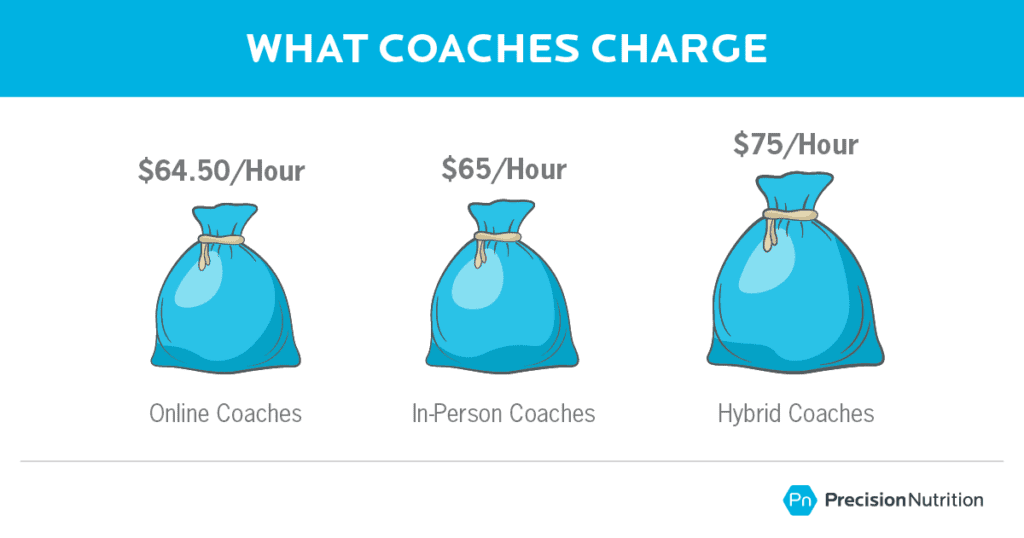
The average wage for the certified coaches polled was $65/hour. (Note that these coaches were all PN-certified. If you end up going with a different certification, the numbers might be comparable, but we can’t say for sure.)
How long does it take to earn a steady income?
How much you make usually depends on how many clients you have (unless you’re hired as an in-house, salaried writer, educator, or counselor). Unlike many conventional jobs, you’re not going to get paid for scrolling through Instagram during work hours.
Honestly, this can be great motivation to work hard, but it can also be really tough. Especially when you’re first starting out and you’re trying to build a healthy roster of regular clients. We have a few tips for getting new clients, but it does take time to settle into a stable income.
In the survey mentioned above, most coaches with one to four clients had two or fewer years of experience.
Coaches with 20 or more clients, on the other hand, were much more likely to have more than three years experience. About a quarter of coaches who were “booked-solid” had six or more years experience.
(Want to learn how to make a living doing what you love? Check out our FREE e-course, How to Succeed in Health and Fitness.)
Yes, you totally need to make money, but my holistic coaching certification was “worth it” in other ways too.
When my elderly neighbor’s wife was recovering from abdominal surgery, I was able to help her stay hydrated and find foods she could digest, allowing her to gain some much-needed weight back.
When my father-in-law had a scary cardiovascular event, and his doctor recommended a special diet to help him lose weight and balance his blood lipids, I was able to coach him to follow his diet, and also to start a regular exercise program.
When my daughter started eating solid foods, I felt confident about what to feed her, and how to prepare it in ways that she would actually eat (okay, and sometimes mash into her hair).
My nutrition certifications continue to bolster my career as a health writer. But mostly, I’m grateful for the countless ways that my knowledge has supported my family, my friends, and my community.
For the record, with my job-hating days behind me, I’m feeling pretty good too.
If you’re a coach, or you want to be…
You can help people build sustainable nutrition and lifestyle habits that will significantly improve their physical and mental health—while you make a great living doing what you love. We'll show you how.
If you’d like to learn more, consider the PN Level 1 Nutrition Coaching Certification. (You can enroll now at a big discount.)

Share