The way our hormones respond to training, and how they affect our muscle growth, depends a lot on our nutritional status — not just how many calories we’re taking in.
What is muscle growth?
Muscle growth — sometimes known as hypertrophy — is the development of mass, density, shape, and function of muscle cells. This adaptation allows the muscle to meet exercise/function-induced stress.
Muscle cells are sort of like a bunch of sticks bundled up for firewood. Myofibrils (“myo”, from the Greek mys, refers to muscle) are cylindrical bundles of filaments composed of sarcomeres. Sarcomeres are the fundamental unit of muscle contraction and are composed of myosin and actin.
All of these proteins comprise about 20% of muscle. Water, phosphates, and minerals comprise the other 80% of muscle.
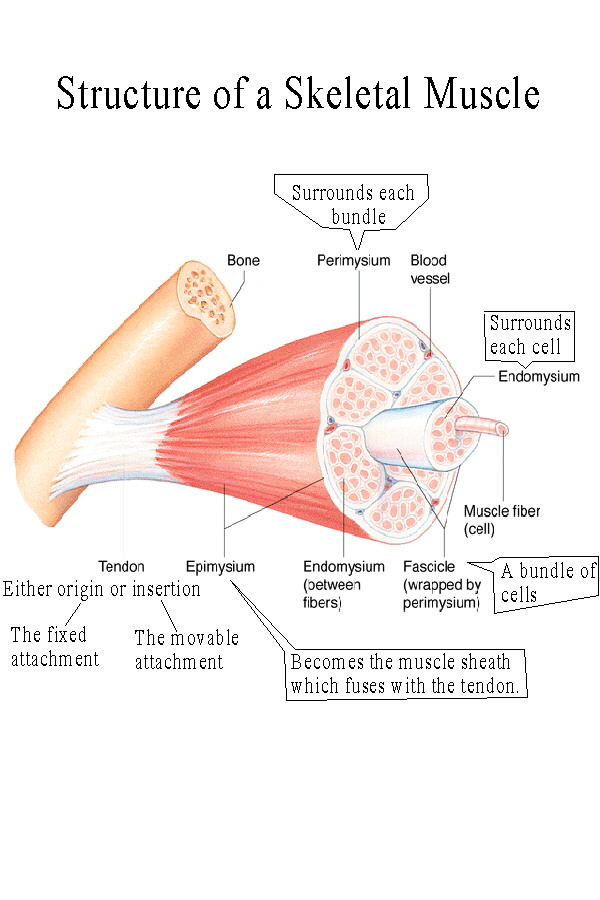
Where does muscle growth come from?
When someone does resistance training consistently, they may notice muscle growth. The growth is due to an increased water, number of myofibrils, and connective tissue.
Scientists often break hypertrophy down into two types:
- Sarcoplasmic hypertrophy increases muscle size by increasing the volume of sarcoplasmic fluid in the muscle cell.
- Myofibrillar hypertrophy (sometimes called “functional hypertrophy”) increases muscle size by increasing the contractile proteins.
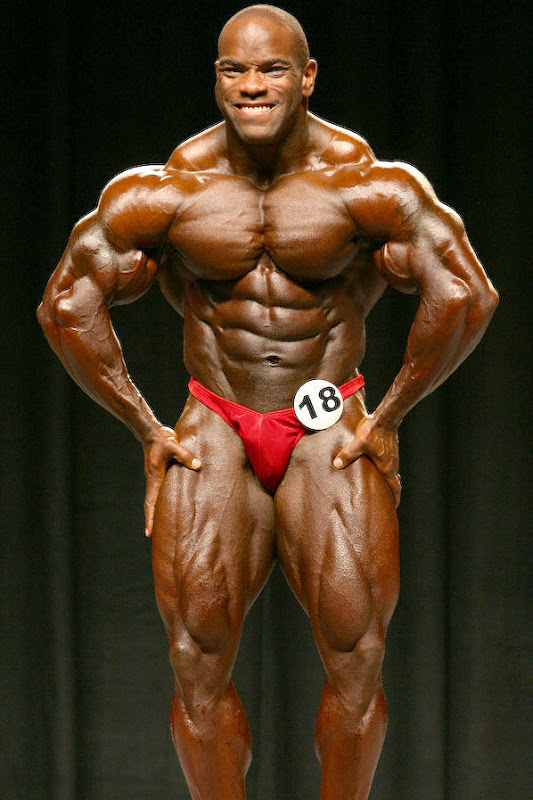
Some people in the fitness industry will argue that bodybuilders demonstrate sarcoplasmic hypertrophy, and that their muscles look “puffy”; while weightlifters demonstrate myofibrillar hypertrophy, and their muscles are “denser”.
| Bodybuilder | Weightlifter |
 |
 |
Muscle growth and fiber types
Although growth can occur in all muscle fibre types, different types of muscle fibres vary in their potential for growth. Fast twitch fibres are more likely than slow-twitch fibres to grow with intense strength training. This may be one reason why athletes such as sprinters tend to be bigger and more muscular than endurance athletes, and why heavier loads tend to stimulate more muscle growth than light loads.
Muscle growth and hormones
Muscle growth is further influenced by type of exercise, nutritional intake, and hormonal status. The type of exercise and hormonal status influence nutrient partitioning — in other words, whether you increase muscle depends on the kind of activity you do and your hormonal environment, which both tell your body where to allocate the nutrients you eat.
Eat a lot, train hard, and get lots of recovery, and you’ll put on muscle. Be malnourished, be sedentary, and be stressed out — and you won’t.
Hormones that modulate muscle growth include:
- growth hormone
- testosterone
- IGF-1
- cortisol
- beta-endorphin, and
- parathyroid hormone.
For more on a few of these hormones, see here:
Why is muscle growth so important?
Subjectively, muscle growth improves the appearance of the body. Women who gain muscle mass while remaining relatively lean appear tighter, firmer, and more “toned.” Men who gain muscle mass while remaining lean appear stronger, larger, and more athletic.
Objectively, muscle growth improves function. Larger muscles are often stronger muscles, leading to improved daily functioning in most individuals. Muscle is metabolically active, and affects the way the body handles nutrients. For instance, people who are more muscular (especially combined with lower body fat) typically have better insulin control.
From a health perspective, advancing age is associated with a loss of muscle mass, better known as sarcopenia. Preserving muscle mass can preserve strength, and strength is a predictor of survival as one ages. Loss of muscle function appears to be due to decreased total fibres, decreased muscle fibre size, impaired contraction mechanisms, and decreased motor unit recruitment.
What you should know
Muscles respond to demands
Muscles respond to the demands we put on them. Ask your muscles to lift loads, and they’ll respond by getting stronger. Ask your muscles to help you make a butt groove in the La-Z-Boy and they’ll shrivel up from disuse, leaving you weak and skinny-fat.
Intense training (such as heavy weight training) damages muscle, which then remodels to prevent future injury. Thus, including relatively intense exercise, particularly resistance training, in your fitness regime is essential — no matter what your ability or age.
Muscles respond to calories
Restrict calories and you risk muscle loss and metabolic slowdown.
Studies show that people who restrict their calories (i.e., diet) without also doing resistance training do lose weight, but it’s an even distribution of muscle and fat — not what you want. Indeed, sometimes calorie restricters who don’t exercise end up fatter (as a %) than when they started!
How many calories to build muscle?
You need roughly 2,800 calories to build a pound of muscle, largely to support protein turnover, which can be elevated with training.
The contractile proteins and fluid (sarcoplasm) in muscle fibres are broken down and rebuilt every 7 – 15 days. Training alters the turnover by affecting the type and amount of protein produced. Again, muscles respond to the demands placed on them.
However, muscles that are overloaded appropriately can actually grow during starvation (energy from fat stores can be liberated and stored in muscle tissue), although ample nutrients (e.g., protein, carbohydrate, etc.) can greatly enhance the extent of the growth response. Although growth can take place during starvation/restriction, especially for newbies, muscle growth with inadequate calorie consumption is less likely to take place with advanced trainees, as their threshold for growth is elevated.
If you’re more experienced and looking to get big and strong, you’ll probably have to eat more.
The chart below shows the results of an experiment done over 16 weeks with 25 overweight women.
The experiment compared calorie restriction alone (diet), exercise alone, and calorie restriction + exercise. As you can see, at the end of 16 weeks, the diet + exercise group lost the most fat and gained a pound of muscle. The exercise-only group didn’t lose as much scale weight, but they lost a fair bit of fat and added 2 lb of muscle. The diet-only group lost scale weight, but not as much fat, and they were the only ones that lost muscle.
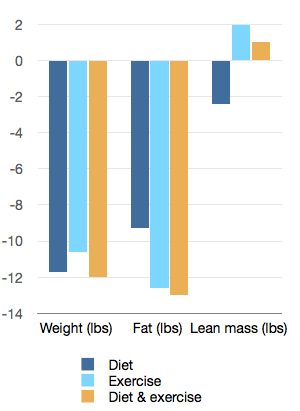
Zuti, W.B. & Golding, L.A. Effect of Diet and Exercise on Weight Loss and Body Composition of Adult Women. The Physician and Sports Medicine. 4 (1): 49-53, 1976.
Muscles respond to protein
The way our hormones respond to training, and how they affect our muscle growth, depends a lot on our nutritional status — not just how many calories we’re taking in.
In a rested state, muscle protein breakdown exceeds protein synthesis. This net balance can be improved with strength training, but still, normally, we’re breaking down more than we’re building up.
We want the opposite — to be building up more than we’re breaking down, especially after resistance training. We need adequate protein to do this.
One bout of resistance training can stimulate protein turnover for at least 48 hours. During this time, if energy intake is adequate and protein represents at least 12 – 15% of our energy intake, growth can occur.
For those on an energy restricted diet for fat loss, protein needs for muscle recovery and growth are likely closer to 1.5 – 2.0 grams of protein/kg of bodyweight.
What helps stimulate muscle protein synthesis?
- Just 6 grams of essential amino acids can stimulate muscle protein synthesis after training.
- We don’t need nonessential amino acids for this stimulation to occur.
- Elevated levels of insulin can generate muscle growth when amino acid consumption is ample, which demonstrates the importance of carbohydrate consumption after exercise.
- Frequent amino acid consumption (from food or supplements) during the waking hours may also play a role in muscle growth.
For more on this:
Summary and recommendations
Muscle growth seems to occur best when training with relatively higher volumes, close to muscle fatigue, and with shorter rest periods between sets/reps.
Thus:
- When training, 6 – 12 repetitions per set is the optimal range for muscle growth.
- Train towards contraction failure.
- Take relatively short rest periods — 30 – 90 seconds. Rest-pause techniques can also be effective.
- Perform 12 – 20 sets per muscle group. Supersets can help add volume and improve efficiency.
- Be consistent with training.
- Consume enough energy (calories), with a minimum of 12 – 15% of calories from protein or 1.0 gram of protein per kilogram of bodyweight.
- Sleep 7 – 9 hours per night.
For extra credit
The amount of muscle growth that occurs depends on upper genetic limits of cell size.
An increase in the number of muscle fibres, rather than just the size of those that already exist, is known as hyperplasia. It has yet to be definitively measured in humans. If it does occur, it probably accounts for a small portion of muscle growth (less than 10%).
Changes in cellular oxygen, reactive oxygen species, ATP levels, and metabolite concentrations during exercise stress may be fundamental stimuli that lead to muscle growth.
References
Click here to view the information sources referenced in this article.
Learn more
Want to get in the best shape of your life, and stay that way for good? Check out the following 5-day body transformation courses.
The best part? They're totally free.
To check out the free courses, just click one of the links below.



Share