Research suggests that whole grains are good for you. But before you feel smug about downing those “whole wheat” pretzels, organic corn chips, or “enriched” Wonder Bread slices, find out the facts about whole grains.
++
What are grains?
Grains are seeds and fruits of cereal grasses, often referred to as “kernels.”
Grains are efficient at transforming sunlight, fertilizer, water, and air into macronutrients. The final product is a durable seed, which can be stored for long periods.
Because grains evolved to last from season to season, we can’t digest them raw. Grains must be flaked, cracked, puffed, popped or ground before being consumed.
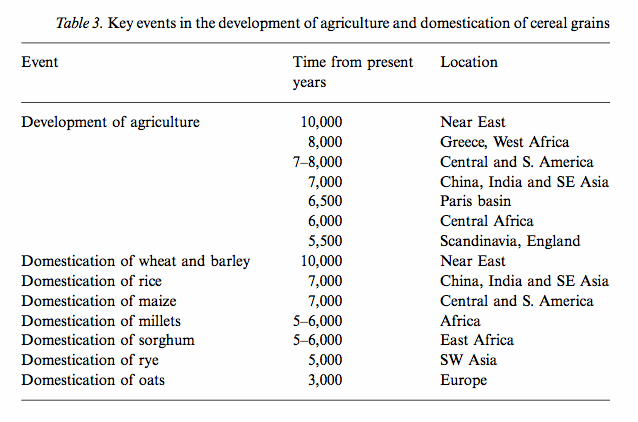
Many whole grains have been cultivated for thousands of years and they’ve been a component of the human diet for that long as well.
Still, humans have been around much longer than several thousand years. There’s some evidence that we may not yet have evolved to digest grains effectively. (More on that below.)
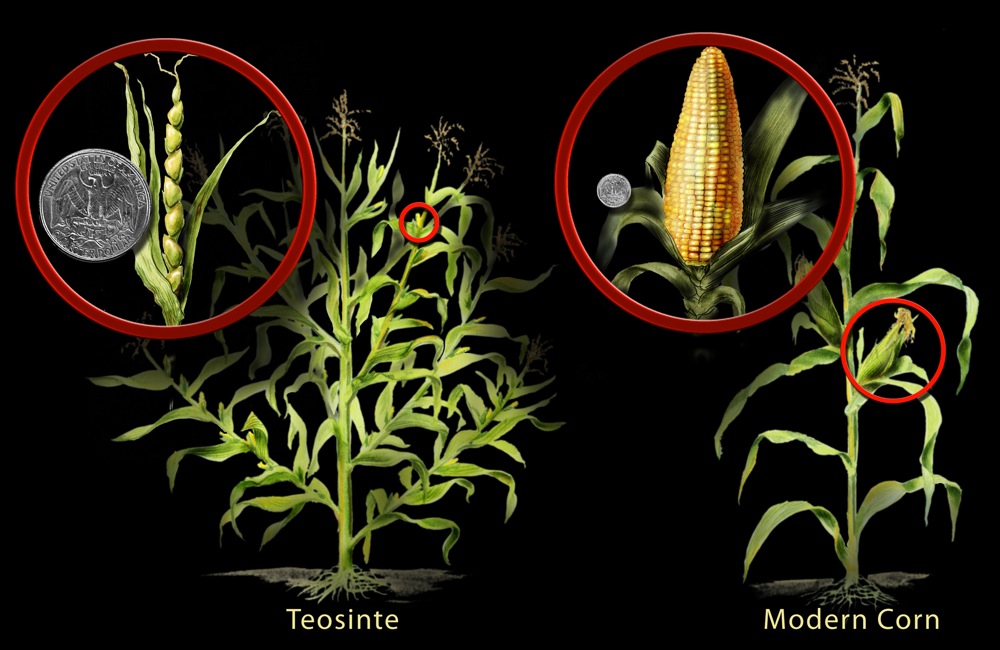
Additionally, early farmers had to breed plants such as teosinte (the precursor of modern corn) in order to create larger, more nutritious and/or digestible grains.
In the past, grains were popular in the winter and early spring since fresh foods were hard to come by and grains could be pulled from storage. Groups could even settle near a grain crop for easier food access.
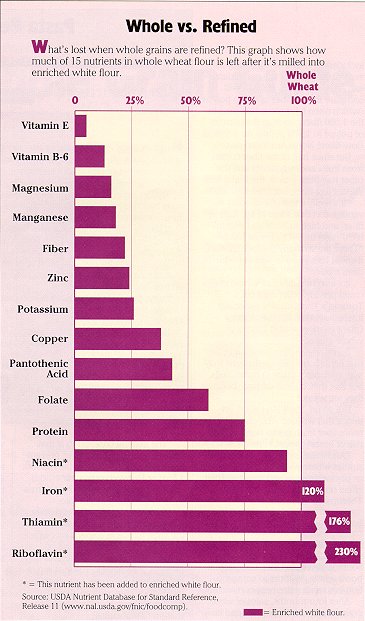
During the industrial revolution we learned that whole grains go rancid faster than refined versions due to the fat content. Milling the bran and germ away makes a product that won’t spoil. Thus, food processors started preserving grain shelf life by stripping away the nutrient rich bran and germ.
Why are grains so important?
Grain – a major industry
Grains are big business.
The world’s four major cereal grains (wheat, maize, rice, barley) contribute more tonnage to humanity’s food supply than the next 26 crops combined.
The U.S. was the world’s second leading grain producer and leading grain exporter from 1995 to 2000, growing about 330 million metric tons of grain (18% of world production) annually.
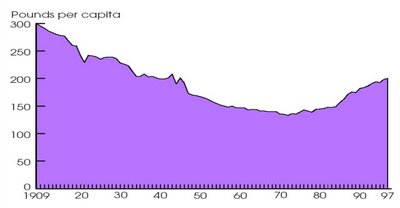
Grains are now a staple part of the Western diet and a major agricultural industry.
Nutrients and processing
However, during the 20th century, an important change occurred in grain processing.
In the 1930s, food scientists realized that refined grains weren’t providing enough nutrients. Eaters, particularly children, were developing symptoms of malnutrition.
Thus, grain enrichment and fortification became standard.
This has often led grain processors to claim that all grain products are “healthy”, when in fact, manufacturers needed to replace many of the nutrients that processing removed in the first place. (More on that below.)
Calorie density
4 pounds of cooked whole grains provides about 1600 calories. Thus, while whole grains are more calorie dense than vegetables and fruits, they are much less calorie dense than nuts, seeds, cheese, processed cereals, chips, steak, sausage, baked goods, etc.
Before modern agriculture, grain intake was varied and sparse due to crop yield variations and limited food transportation.
Now, many people consume a grain-rich food — usually a refined grain — at nearly every meal. They might have a pastry for breakfast, pretzels for a snack, bread for lunch, pasta for dinner, and cake for dessert. Holy excessive grain intake!
What you should know about grains
93% of Americans fail to consume ½ cup of whole grains per day.
Why do so many people claim that “carbs” make them fatter? Maybe because the average North American eats about 1 cup of refined grains – every day.
People who eat enough whole grains have a reduced risk of heart disease, diabetes, and cancer. Conversely, consuming refined versions of these grains leads to the development of chronic disease.
Some have theorized that grains containing gluten may be a detriment to health. See All About Gluten for more.
What’s in whole grains? (That’s not in refined grains.)
Fiber
Whole grains contain fiber. Fiber is a critical component of health.
The subtraction of fiber from our diet is likely a major source of chronic disease. Low fiber intake has been linked to constipation, hemorrhoids, appendicitis, diverticulitis, polyps, and cancers. (Still, other cultures, such as indigenous Arctic people, have survived just fine without high levels of fiber.)
Because fiber is not digestible, just 89% of the typical primitive diet was available for energy. Compare that to 93% in the modern diet.
Energy
We now get more energy from our food because it’s more highly processed. For our active ancestors, more calorie energy would have been very welcome, especially during lean periods. For us, not so much.
Excess energy means more calories to cells and potential weight gain.
Resistant starch, aka “prebiotics”
Whole grains not only contain fiber, but resistant starch, another potentially healthy compound. It might help to prevent cancers, control blood sugar, and promote the growth of healthy bacteria in the gut.
Vitamins and minerals
Whole grains are seeds that will sprout when conditions are right, so they’re loaded with nutrients for a potential plant. Think essential fatty acids, B vitamins, minerals, and macronutrients.
Anti-nutrients
However, whole grains also contain anti-nutrients that can render the nutrients in them useless to us. These anti-nutrients do things like inhbit our absorption of minerals from the grains.
Luckily, soaking and germinating grains deactivates the anti-nutrients. Adding yeast to bread (and letting it sit) can help to break down these anti-nutrients as well. See All About Lectins for more.
Grains tend to be acid forming foods. For more on diet and acid-base balance see All About Dietary Acids and Bases.
Sure, I eat lots of whole grains… don’t I?
Most people don’t know much about astrophysics. Same goes for whole grains.
Have you ever:
- Consumed bread with wheat flour? That’s not a whole grain.
- Had crackers with enriched flour? That’s not a whole grain.
- Mixed wheat germ into your smoothie? That’s not a whole grain.
- Made a batch of oat bran granola bars? That’s not a whole grain.
Whole grains are just that — the whole thing. Not flour. Not pieces of the grain. The whole shebang.
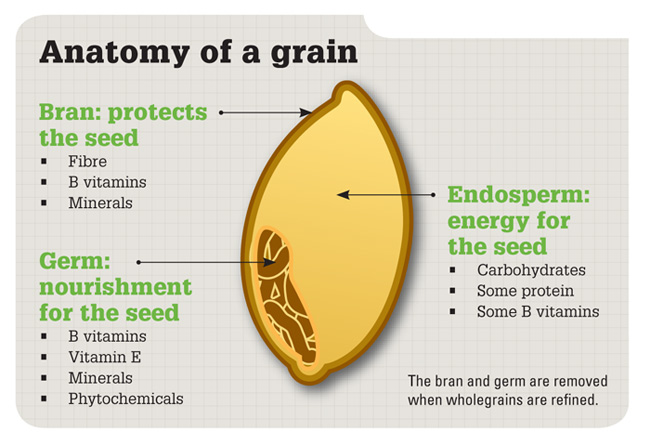
- The hull is the outer covering and is inedible; it’s used to protect the grain and is removed before grinding.
- The bran retains moisture and is rich in nutrients.
- The germ is the base and necessary for sprouting. When you plant a grain, the germ becomes a new plant. (Think of it like a plant embryo.)
- The endosperm is large and has mostly starch and protein. It’s fuel for the germinating plant and what makes up white flour.
Grain processing
Unlike herbivores with multi-chambered stomachs who can live on shrubbery, we can’t just grab a grain seed off the stem of grass and start noshing. We need to process grains in order to digest them.
Genetic research shows that farmers in the Neolithic era bred plants such as corn to make them more edible.
A few popular methods include:
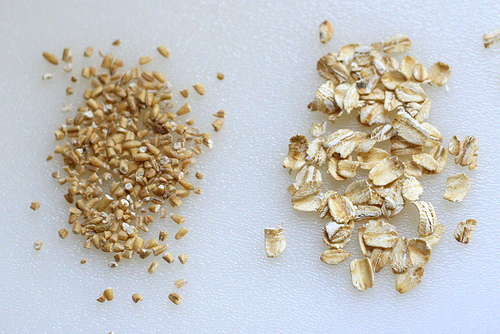
- Cracked: The grain is cracked into larger pieces.
- Steel cut: The grain is cut into about 3 pieces.
- Rolled: The grain is steamed and rolled flat between two smooth rolls.
- Puffed: The grain is puffed up using high pressure and steam.
- Pearled or polished: The outer grain layers are stripped away to a varying degree.
- Ground: Often called “meal.” Think oatmeal or cornmeal.
- Soaked/sprouted: This is a malted grain. It’s dried and matured before milling.
Whole grain types
Now that we are familiar with processing methods, what are some whole grain options?
Oats: Regular oat groats (the whole grain form) are vulnerable to rancidity due to the fats. Thus, they are usually rolled and heat treated. This is how most oats are sold.
Whole wheat: Wheat was one of the first plants that humans cultivated. Wheat is useful in breads due to the higher gluten content.
Quinoa: A pseudograin and member of the spinach and chard family. It may contain up to 22% protein. Make sure to rinse away saponins – chemicals that are present to deter foraging animals.
Amaranth: Another pseudograin. It’s a member of the spinach and chard family.
Corn, aka maize: A staple in native civilizations for thousands of years. However, the original varieties were less sweet, and smaller, than the high-sugar versions used today. There were at least 12,000 indigenous varieties of maize in the Americas. Now, only a handful of varieties are grown industrially.
Brown rice: Long grain rice is higher in amylase. Short grain rice is higher in amylopectin, making it stickier. 6 out of 10 people in the world eat rice each day.
Wild rice: Not true rice, rather an aquatic grass. Traditionally, Native people in North America harvested the grain by knocking the seeds off the stalks into canoes. This method is still used today.
Along with a pleasant nutty taste, wild rice has lots of protein and fiber. It needs to be soaked before cooking.
Barley: Provides the makings for beers and malt spirits. One of the first cereals cultivated in the Middle East. Barley is a perennial and gentler on topsoil. Barley has 3 times the protein of rice.
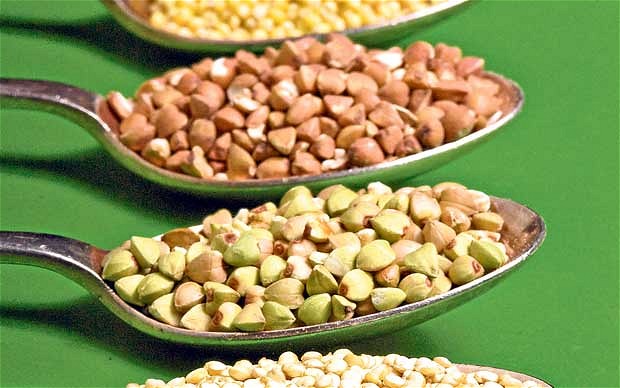
Buckwheat: It actually contains no wheat. You may see it sold as kasha. This is a pseudograin with a unique conical shape. It’s actually related to rhubarb.
Millet: Some think dinosaurs were around for this stuff. It’s used in birdseed and very easy to digest.
Spelt: A cousin of wheat. A bit harder to process because of the husk.
Grain consumption
Not many cultures eat abundant amounts of varied cereal grains. They may have one or two grains they eat, but rarely combine many.
Instead, they consume other foods like tubers, veggies and fruits for energy.
If you are hoping to meet your whole grain quota by eating at a restaurant, think again. On average, 1,000 calories of restaurant food provides less than 0.4 ounces of whole grains. Count Chocula thinks that’s pathetic. You’d have to eat over 10,000 calories of restaurant food to meet your goal for the day. (And apparently, some restaurant buffets are set up to enable just this very project.)
Hello, obesity!
The most significant change in grain technology over the past several years was the introduction of genetically modified (GM) crops. This include “Bt-corn.” See All about GM foods for more.
Presently, about 14% of corn grown in the U.S. is used for biofuel production.
Grain fed to animals
About 75% of all the grain we produce worldwide is fed to animals. That’s about 250 million metric tons of grain.
Does that go to all of our pet hamsters? Nope. It goes to livestock to satisfy our high animal based diets.
This is a recent phenomenon, as livestock have only been fed grains for a short time. And it doesn’t work too well for them. Well, unless you consider E. coli and acidosis a good thing.
Healthy animals need a varied diet, including lots of grasses — and, in the case of poultry, small animals such as worms and grubs.
Soil impact of grains
Producing lots of grain for animals not only makes the animal unhealthy, it makes the soil unhealthy.
Most grains are “annual” crops and must be planted every year. This type of crop can wreak havoc on topsoil. Last time I checked, topsoil was important.
Summary and recommendations
Including cereal grains, along with a variety of other high quality foods seems to be a healthy option for people who can tolerate them.
There are two key nutritional concerns about grains:
- Whole versus refined grains
- Proper digestion of grains
Consume WHOLE, not partial, grains
Not many of us consume excessive amounts of whole grains. Aim for at least ½ cup of whole grains each day to help prevent disease and improve health.
When shopping for whole grains, look for organic and fair trade varieties. Store in a cool, dark, dry place or in the refrigerator.
Preparation methods can improve digestion
Experiment with grains you enjoy and tolerate well. Also experiment with different preparation techniques.
With whole grains, consider:
- Cleaning – Like most any product from agriculture, you’ll want to wash your grains. This helps rinse away dust and grit, but also in the case of some grains, saponins that can cause digestive upset. Use a fine mesh strainer.
- Soaking – Just like with beans, this can help to rid the grain of anti-nutrients and shorten cooking time.
- Fermenting — Similar to soaking, this process uses the natural yeasts to convert anti-nutrients in the grains.
- Toasting – This can bring out the flavor and decrease cooking time.
- Cooking – Try baking, steaming, pressure cooking, etc.
- Sprouting — Some grains such as quinoa will sprout fairly quickly, within several hours or 1-2 days.
Extra credit
In the 1960s, authors published an article claiming that heart disease, obesity, diabetes, peptic ulcers, and appendicitis constituted the manifestations of a single, primary disorder that could be called “refined-carbohydrate disease.”
Whole grain flours should be kept in the refrigerator or freezer unless you plan on using them within one month of processing.
A few thousand years ago, grain processing was a first-rate job.
An average, a wheat stem produces 30 to 50 kernels.
Wheat can be described as hard or soft, referring to the texture of the endosperm, which is affected by the amount of protein contained within it.
In 1900, 8 out of 10 loaves of bread eaten in the U.S. were made at home. By 1924, that figure dropped to 3 out of 10.
In 5000 B.C. we started cooking grains as porridges and gruel. Then, coarse ground flatbreads became popular (e.g. Mexican tortilla, Ethiopian injera, Indian chapatti).
Some experts claim that if we replaced refined grains with whole versions, cancer rates would decrease by nearly 40%.
Some feel that refined grains are to blame for the countless cases of high blood pressure.
You can make your own whole grain flour in small batches using a coffee grinder. Or, perhaps, a more exercise-friendly setup:

References
Click here to view the information sources referenced in this article.
Eat, move, and live…better.©
The health and fitness world can sometimes be a confusing place. But it doesn't have to be.
Let us help you make sense of it all with this free special report.
In it you'll learn the best eating, exercise, and lifestyle strategies – unique and personal – for you.



Share