Originally published July 2022. Last reviewed and updated by the Precision Nutrition editorial team, May 2026.
“Eat fewer processed foods.”
Nearly every health expert says it. (Sometimes so often that you’ve maybe tuned it out. Kind of like when they say, “Eat your greens.” Whatever, Mom.)
But have you ever wondered why?
Plus, what even counts as a processed food anyway?
In the following infographic, we cover everything you need to know about processed foods.
You’ll discover:
▶ What counts as “processed” (and and what doesn’t)—and how those foods affect your health
▶ The difference between four types of processed foods (whole foods, minimally-processed foods, moderately-processed foods, and highly-processed foods)
▶ Which processed foods benefit your health and well-being—as well ones that might harm it
▶ How to tell which whole and minimally-processed foods are worth the effort (and which likely aren’t)
Plus, you’ll get a three-step process that’ll help you boost your consumption of nutrient-packed foods—without feeling deprived or overwhelmed.
This isn’t about forcing yourself to eat foods you hate. Nor is it about finding 45 extra minutes that don’t exist in your day.
Rather, you’re about to discover a nutritional middle ground that can help you to transform your diet, one (manageable) action at a time.
Check out this infographic to learn more. (Or, download the file to refer to whenever you need it.)

What does “processed” actually mean?
Here’s something that throws a lot of people: Nearly everything you eat is “processed” in some way. Steaming spinach? That’s processing. Grinding wheat into flour? Processing. Pasteurizing milk? Ditto.
So when nutrition experts (yes, including us) tell you to “eat fewer processed foods,” what they really mean is to eat fewer highly processed foods.
The most useful way to think about it isn’t “processed or not” but “how much, and what kind.”
Researchers at the University of São Paulo formalized this idea with a system called NOVA.1 It sorts foods into four groups based on how much they’ve been transformed from their original state. NOVA is the framework most current nutrition research uses, and it lines up almost perfectly with the four-tier system shown in the first box in the infographic above.
The four tiers, from least to most processed:
- Whole foods (an apple, a chicken breast, a handful of almonds)
- Minimally-processed foods (rolled oats, frozen blueberries, plain Greek yogurt)
- Moderately-processed foods (canned beans, whole-grain bread, cheese, jarred tomato sauce)
- Highly-processed (or “ultra-processed”) foods (chicken nuggets, soda, packaged cookies, sugary breakfast cereals)
The first three tiers are usually fine—great, even. It’s the fourth tier that does most of the damage.
The four tiers, with grocery-aisle examples
Let’s get specific. If you can’t tell which category a food falls into in three seconds at the grocery store, the framework isn’t useful in everyday life.
So let’s explore the concept using some practical examples.
Tier 1: Whole foods
These are foods that are essentially in their natural state, or only altered by basic preparation like washing or refrigeration.
- Fresh fruits and vegetables
- Raw nuts and seeds
- Fresh meat, fish, poultry, eggs
- Dried legumes
- Plain dairy (whole milk, unflavored yogurt)
- Whole grains in their original form (steel-cut oats, brown rice, quinoa)
Eat these freely. They form the foundation of nearly every evidence-based dietary pattern, from Mediterranean to Vegetarian to Paleo.
Tier 2: Minimally-processed foods
These are foods that have undergone simple processing—usually for safety, convenience, or shelf life—without significantly changing their nutritional profile.
- Frozen fruits and vegetables (without anything added, often ffrozen at peak ripeness)
- Bagged pre-washed salad greens
- Pasteurized milk
- Plain Greek yogurt
- Rolled oats
- Roasted (unsalted) nuts
- Plain ground meats
- Canned fish in water
These are often kitchen staples. They’re nutritionally close to whole foods, plus they’re often cheaper and more convenient—and they’re not worth avoiding due to the minimal processing they undergo.
Tier 3: Moderately-processed foods
These are foods made by combining several minimally-processed ingredients, often with salt, fat, or sugar added during cooking or preservation.
- Whole-grain breads
- Canned beans with salt
- Cheese
- Jarred tomato or pasta sauce
- Hummus
- Whole-grain crackers
- Simple canned soups
- Cured meats (in moderation)
These are fine in regular rotation. The key is checking the ingredient list—if you recognize most ingredients and could (theoretically) make the food in your own kitchen, you’re good. (For a full breakdown of how to read ingredient labels, see: Food labels part 1: What’s on your food label?)
Tier 4: Highly-processed (ultra-processed) foods
Industrially-produced products built from extracted, refined, and chemically-modified ingredients—usually with additives like emulsifiers, artificial flavors, stabilizers, and high-fructose corn syrup.
- Soda and sweetened beverages
- Packaged baked goods (cookies, snack cakes, most commercial breads)
- Most breakfast cereals (especially the colorful, exciting ones marketed to kids!)
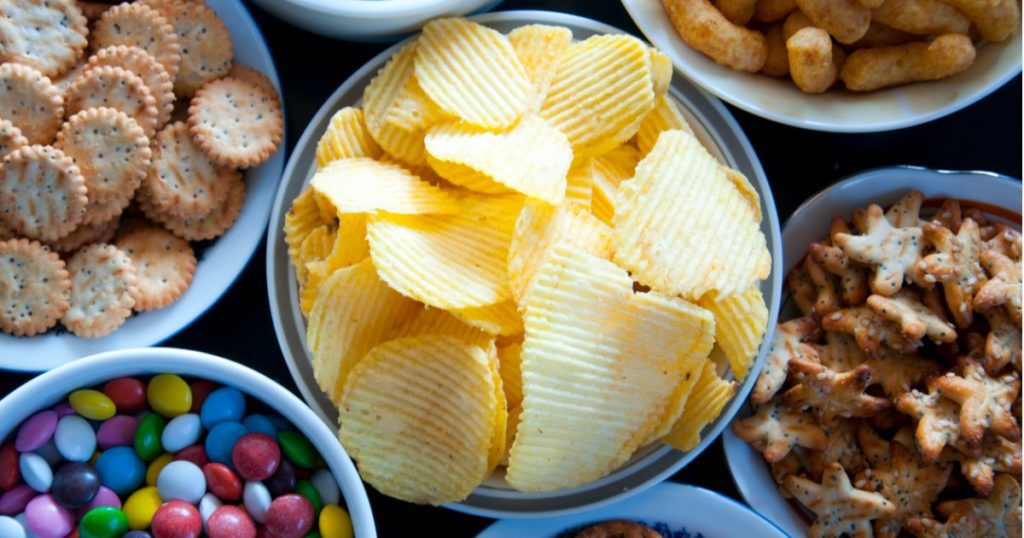
- Chips, cheese puffs, flavored crackers
- Frozen meals, pizzas, chicken nuggets
- Hot dogs and most processed meat slices
- Candy
- Most “energy bars” and protein bars (read the label)
This is the tier worth watching. Not banning—just watching.
Why minimally-processed beats ultra-processed (most of the time)
Here’s the research that should make you pay attention.
In 2019, NIH researcher Kevin Hall ran a tightly-controlled study published in Cell Metabolism.2 Twenty adults lived in a research unit for a month. For two weeks they ate ultra-processed meals; for the other two weeks they ate minimally-processed meals. All the meals served in both conditions were matched for calories, macronutrients, fiber, sugar, and salt, and participants could eat as much or as little as they wanted at each meal.
The result: People ate about 500 calories more per day on the ultra-processed diet. They also gained weight on it—and lost weight on the minimally-processed one.
Same macros. Same calories on offer. Same sugar. But the ultra-processed meals drove people to eat more.
Why? A few likely reasons:
- Ultra-processed food is engineered for “passive overconsumption”—soft textures and intense flavors mean less chewing, faster eating, less satiety per bite.
- The “food matrix” matters: When nutrients are “packaged” inside a whole-food structure, your body absorbs them more slowly, which moderates appetite signals. (More on this here: The importance of micronutrients—and where they fit in your diet)
- Large observational studies—including major analyses published in the BMJ in 2019—have linked higher ultra-processed food intake to increased risk of cardiovascular disease, type 2 diabetes, and all-cause mortality, even after adjusting for total calories and body weight.3,4
When ultra-processed is actually fine
Sometimes you’ll hear well-intentioned advice that sounds like this: “Ultra-processed is poison, so you should never eat it!” But in reality, the practical takeaways are more nuanced than that.
For example:
- Whey protein powder is technically ultra-processed, but it’s also one of the most useful tools we recommend for clients trying to hit protein targets.
- Protein bars can be ultra-processed and still be a reasonable on-the-go option when the alternative is skipping a meal entirely.
- Frozen meals vary wildly. A microwaveable lasagna loaded with hydrogenated oils is a different beast from a frozen entrée with whole-food ingredients and few chemical additives.
- Even soda has its place—at a birthday party, on a sunny patio with friends, occasionally. Banning it outright is usually what creates the rebound.
The goal isn’t zero ultra-processed food. The goal is to make ultra-processed food the minority of your intake, and to be intentional about when you eat it rather than reaching for it on autopilot.
A useful target for most people: Roughly 80 percent of your food intake should come from tiers 1–3, and 20 percent from tier 4. If you’re trying to lose fat or improve specific health markers, consider pushing that toward 90/10. If you’re maintaining and life is busy, 70/30 is awesome too.
How to upgrade your shopping cart: A three-step framework
If you want to move towards a more whole and minimally-processed food diet, here’s our three-step process for how to begin.
Step 1: Audit your kitchen this week
Walk through your pantry, fridge, and freezer. For every packaged food, check the first three ingredients on the label. If any of them are:
- Refined flour (“enriched wheat flour,” “white flour”)
- Refined oils (soybean, corn, cottonseed)
- Any kind of added sugar (“high fructose corn syrup,” “cane syrup,” “evaporated cane juice”)
…that item is probably tier 4. You don’t need to throw it away. Just notice it. Awareness comes first. (If you want a deeper guide on reading nutrition labels, check out: The food label series: Do labels help or hurt us?)
Step 2: Make one replacement per week
Pick one tier-4 food you eat regularly and find a tier 1–3 swap. Don’t try to swap everything at once—that’s what makes diet changes fail.
Examples:
- Flavored yogurt → plain Greek yogurt with a drizzle of honey and fresh berries
- Sweetened breakfast cereal → rolled oats with banana and almond butter
- Bottled salad dressing → olive oil, lemon, salt, pepper, mustard
- Granola bars → a handful of raw nuts and a piece of fruit
- Frozen breakfast sandwich → two eggs and a piece of whole-grain toast
One swap per week. After three months, you’ll have replaced 12 staples—which is probably a good proportion of your weekly diet!
Step 3: Create some “default snacks”
Often, the biggest ultra-processed food trap isn’t main meals. It’s 3pm at your desk, or 9pm on the couch. Make your default snacks tier 1–2 by:
- Keeping cut vegetables and hummus at eye level in the fridge
- Pre-portioning nuts into small containers so you can grab one
- Keeping fresh fruit on the counter where you’ll see it
- Hiding (or just not buying) tier-4 snacks for casual at-home eating; save them for occasions you actually plan and go out deliberately to eat
Defaults beat willpower every time. (For more on building meal habits that stick, see our handy infographic: Weekly meal prep: Mastered)
Frequently asked questions
Are frozen vegetables processed?
Technically yes—but they’re “minimally processed” (tier 2). They’re frozen at peak ripeness, often have more retained nutrients than fresh vegetables that have spent a week in transit, and have zero additives in their plain form. So you can feel good about adding these staples to your cart.
Is canned tuna a processed food?
Yes, but it also gets a green light. Plain canned tuna in water is moderately processed, but it’s also a cheap, shelf-stable, lean protein source—so it’s a good return on investment, with few tradeoffs. Just read the label and avoid versions with added oils, sweeteners, or excessive sodium.
What’s the actual difference between “processed” and “ultra-processed”?
Processed foods have been altered from their natural state—cooked, fermented, canned, frozen—but you can still identify the original ingredient(s). Ultra-processed foods are built from extracted, refined, or chemically-modified components and usually contain ingredients you wouldn’t find in any home kitchen (such as maltodextrin, soy protein isolate, “natural flavors,” etc.).
Is bread always processed?
Bread is by definition processed—you can’t get bread without milling and baking, which are both forms of processing. But there’s a huge range. A sourdough loaf from your local bakery (flour, water, salt, starter) is moderately processed. A long-shelf-life sliced sandwich bread with 20+ ingredients and added emulsifiers is ultra-processed. Read the label.
Are protein bars healthy?
It depends. Bars with a short ingredient list (nuts, dates, real protein source, cocoa) are moderately processed and useful. Bars with 30+ ingredients including sugar alcohols, artificial sweeteners, and a long list of additives are ultra-processed. The “high-protein” claim alone doesn’t make a bar healthy.
How much ultra-processed food per day is okay?
For most people aiming for general health, keeping ultra-processed foods to roughly 20 percent of weekly calories is a workable target. For specific physique or health goals, lower can better. The exact number matters less than the trend—are you moving toward more whole foods, or away from them?
Should I avoid foods with ingredients I can’t pronounce?
This rule sometimes gets overemphasized. Some hard-to-pronounce ingredients are just chemical names for ordinary nutrients (ascorbic acid = vitamin C). The better rule is the number of ingredients and whether they’re whole-food-derived. Three pronounceable ingredients doesn’t mean a food healthy if those ingredients are sugar, sugar, and more sugar. (See our full guide on what to look for: The surprising truth about sugar)
The bottom line
“Processed food” isn’t a single thing. It’s a spectrum, and most of it is fine—even good for you. The narrow slice that’s worth moderating is tier 4: ultra-processed foods.
That said, you don’t need to overhaul your kitchen this weekend. Audit what you have. Swap one tier-4 food per week for a tier 1–3 alternative. Build a few good snack defaults. In three months, your diet will look meaningfully different—without ever having “started” a diet.
References
Click here to view the information sources referenced in this article.
If you’re a coach, or you want to be…
You can help people build sustainable nutrition and lifestyle habits that will significantly improve their physical and mental health—while you make a great living doing what you love. We'll show you how.
If you’d like to learn more, consider the PN Level 1 Nutrition Coaching Certification. (You can enroll now at a big discount.)
Share