You’ve probably heard that working out causes weight gain (instead of loss). Well, it’s true. If you see ‘working out’ as an unpleasant chore, you’re more likely to make poor nutrition choices and undo your efforts. But if you have fun with physical activity, you’ll get better results, more quickly.
- Want to listen instead of read? Download the audio recording here…
++
I was having dinner with my girlfriend recently at a beachside restaurant. We sat outdoors, under a canopy of trees, overlooking the ocean.
There were other tables around us, and a few families. Kids who had grown bored of grownup talk had abandoned their seats and were playing on the beach.
A little girl, maybe four years old, shot past us, ricocheted off a tree and skidded to a stop near our table.
She was wielding an imaginary sword, fighting off a horde of imaginary ninjas or pirates and—thanks to her lightning-fast reflexes and karate chops—seemed to be winning.
After a series of kicks, rolls and sound effects, she popped triumphantly to her feet, hurtled over a stone retaining wall, and sprinted away.
For most kids, physical movement is a joy. It’s an inherent part of play, and it’s just how you get around. It’s what you do for fun, to get home from school, or to escape a band of pretend pirates.
They don’t move around begrudgingly, because they feel like they have to. They move around because it’s fun.
Exit play, enter adulthood
When we become adults, something changes.
We don’t swordfight pirates anymore. We battle our email inboxes. (Which are very unfun opponents.)
We sit in cars or trains on our way to work, where we sit at desks. At the end of the day we return home, and sit down to relax.
Movement becomes a smaller part of our day, and our bodies adapt to this. Joints stiffen. Posture changes. Metabolisms shift.
We put on weight. We’re not happy about this. Hoping to change things, we put movement back into our lives.
The prescription: exercise
As grownups, we don’t do this by cartwheeling across the beach to kick an imaginary ninja in the face. We do it through this thing called exercise.
We exercise at home, with a DVD workout or a dusty set of dumbbells.
Or we join a gym. In which we hamster away on treadmills that face TVs. Or a wall.
Or maybe we try to stay outside, and we go running, walking or ride a bike for exercise.
But there’s a problem here.
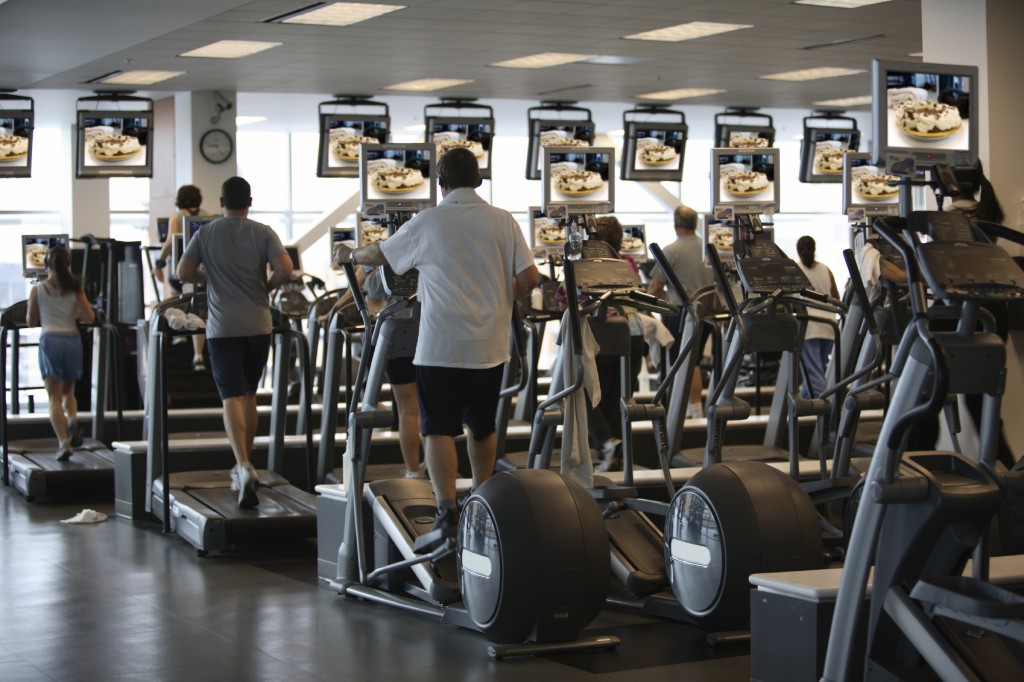
Exercise doesn’t work
To save you some time, this article talks about how a bunch of research has shown that people who exercise regularly (even with a top-notch program) without addressing the way they eat often don’t lose much—or even any—weight.
(In some cases, working out causes weight gain.)
People can spend thousands of dollars. Hours upon hours of time. They can work hard. And really, really want to do the right thing.
Yet… after several months the scale will have barely budged. They might switch out a little fat for a little more muscle, but it’s not a big change.
This doesn’t mean that exercise does nothing, of course. It still preserves lean muscle mass and bone density, improves fitness, makes important biochemical changes and enhances cognitive function and mood. Important stuff.
Exercise + nutrition does work
The obvious piece of the puzzle here is nutrition. When exercise is combined with good nutritional habits, the results can be amazing. We’ve seen this thousands of times in our coaching programs.
Nutrition alone can work fairly well for weight loss, in some cases. Exercise without nutrition, not so much.
Combine the two, and the results can be life-changing.
This is still puzzling, though.
How is it that exercise, which can have a massive physiological impact, doesn’t change our bodies without nutrition interventions?
Hedonic compensation
You might know the term “hedonism”, which refers to the pursuit of pleasure.
The theory of hedonic compensation suggests that if we feel like we “lose out” on pleasure in one area, we look to compensate for it elsewhere. (Thus, the thought process of “I’ve had a lousy day; I deserve a treat.”)
In 2014, researchers explored three different studies that help to show why exercise alone doesn’t usually produce weight loss.
In these studies, they found that perceiving a physical activity as “fun”, rather than “exercise” meant that:
- People chose less junk food during meals.
- People ate less candy when offered a snack from a self-serve container.
- People chose “healthy” snacks more often than “unhealthy” snacks.
In other words, because exercise is not seen as fun, people compensate by finding fun elsewhere.
What they learned
Study #1
Thinking of movement as “exercise” instead of “fun” makes people get more of their calories from sugary desserts.
Participants walked 30 minutes around a university campus. Half of them were told that the walk was for exercise, and half that it was for fun. Both groups got a free lunch after their walk, with both “healthy” and “unhealthy” options.
Study #1 Results
People ate the same amount of calories. But there was a difference in the type of calories. People in the exercise group served themselves larger portions of the “junk food” options, and ate more from those portions than people in the fun category.
Study #2
Thinking of movement as exercise instead of fun makes people serve themselves more candy.
In another study, a group of participants were once again asked to walk—some for exercise, and some for fun (sightseeing).
Afterwards, participants were invited to help themselves from a large bowl of M&M candies by scooping some of them into a Ziploc bag.
Study #2 Results
The people in the exercise group served themselves substantially more M&Ms (372 calories worth, on average) than the people who had done the same physical activity but with a ‘fun’ mindset (166 calories, average).
Study #3
The less fun runners have in a race, the more likely they are to choose a candy bar afterward instead of a healthier option.
A third study examined runners doing a race: a relay in which people took turns running between about 5 and 7 kilometers.
Once runners had finished the race, they were asked to fill out a questionnaire about how they felt about the race, then given a choice of a snack: either a “relatively healthy” cereal bar, or a “relatively unhealthy” chocolate bar.
Study #3 Results
The runners who had the most fun during the race were also the most likely to choose the healthy snack. Enjoying the race less meant a greater chance of choosing the unhealthy snack.
Intrinsic reward vs. extrinsic reward
To understand more about this exercise vs. fun dilemma, it helps to understand the difference between intrinsic and extrinsic rewards.
- Intrinsic rewards mean that we do things for some inner reason. Like fun. Or interest. Or the joy of learning. Or the quiet triumph of solving a puzzle. Even if nobody sees us doing those things, we feel good about them. And we enjoy the entire process, regardless of our results.
- Extrinsic rewards mean that we do things for some external validation, measurement, or approval. Like a trophy or a medal. Or public recognition. Or a timer or calorie counter. Or other people saying “Good job!”
A theory called activity engagement theory suggests that when an activity is intrinsically rewarding, we don’t feel the need to compensate—or be compensated—for doing it. The activity itself is the reward.
But when we’re doing something that’s extrinsically rewarding, we’ll naturally seek an external reward to follow it. We don’t usually enjoy the process much, since we’re so focused on the results, and making sure other people or things see those outcomes.
Makes sense, of course. After all, we don’t put in 40 hours a week at an office job for the sheer joy of sitting in a cubicle, staring at a glowing white square. We want the paycheck, and maybe the social status of being Assistant Vice Manager for the 11th District.
On the other hand, we usually don’t expect any recognition or reward for doing our favorite hobby. We just like making quilts or fly tying or paint-by-numbers or whatever else we’re into.
This is part of the reason that exercise alone doesn’t work, and why exercise plus nutrition coaching does.
We’re seldom in the gym sweating away because “Gosh, there’s nothing I’d rather be doing with my time right now than pushups,” but because of the future payoff.
And when our motivation has to come from outside the activity, and not from the inherent joy of the activity itself, we’re more likely to fall into the hedonic compensation that these studies highlight.
In other words, we’ll feel (even if unconsciously) like we “deserve a treat” because we dutifully did the chore of exercise.
The good news is that by adding nutrition coaching, or even just awareness of your eating, you can prevent hedonic compensation, and make many other helpful changes.
Turning ‘exercise’ into ‘fun’
But what happens when we exercise and the compensation drive isn’t there, because we had fun while exercising? Remember, the people in these studies were doing the same physical activity; they were just thinking about it differently.
When movement becomes intrinsically rewarding, the whole process becomes easier.
We’re more likely to engage fully and exert ourselves more. (Think about how excited you are to dive for a frisbee if you love Ultimate, or tackling the double-black-diamond run if you love snowsports.)
If we love what we do, we no longer need to “white knuckle willpower” our way into avoiding the hedonic compensation effect afterward.
Nutrition is still valuable, but now instead of focusing our nutrition efforts on avoiding negative things (“Don’t eat the cookie, don’t eat the cookie…”), we can use more of our energy to seek positive things (“Let’s try out this new recipe!”).
We get better results. We’re happier. Activity is joyful.
That’s a powerful shift.
We can make exercise more effective by making it more enjoyable.
In other words, making your physical activity fun isn’t an indulgence. It’s a powerful—maybe even essential—long-term weight-loss strategy.
For trainers and coaches: Structure training around improving skills
Making exercise fun is a fine line to walk as a coach, because you have to design workouts that are both enjoyable and accomplish your physical goals for the session. You have to balance intrinsic reward with an external purpose.
The bridge between work and play is deliberate practice, which requires focused engagement and constant feedback on a challenging task. It’s not fully play, but people still find it motivating to feel like they’re getting better at something.
If you want to help your clients enjoy deliberate practice, try these tips:
- Direct your client’s attention to specific parts of the process, such as the way their knees or hips are moving in an exercise. This helps clients tune into their own skill development, which can be highly rewarding.
- Make sure clients understand and can do what you’re asking. Otherwise, you’re setting them up for frustration and disappointment.
- Work at a level of “desirable difficulty” that makes the effort challenging, but still allows clients to be generally successful. Winning is fun!
- Give immediate feedback (either from you, or from their own self-monitoring) about how well they’re doing. Clarity eases insecurity and anxiety.
- Help them see their progress in the long-term (over weeks and months) as well as short-term (within the workout). Call out and celebrate that progress, no matter how small.
What to do next
Think about what you might enjoy.
Each person has their own ideas about what movement is “fun” or intrinsically rewarding. Experiment. Try stuff.
Make the program fit you, not the other way around.
Work with your body, your lifestyle, your schedule, and your interests. Do what you love.
Build on success.
Sniff out fun and enjoyment like a bloodhound. Look for small victories and little joys everywhere. Then, build on them.
Make it social.
Whether it’s taking turns under the bar in a squat rack or meeting up for a morning run, training is more fun with friends, and we’ll often push ourselves harder than we would if we were training solo.
Think “movement” instead of exercise. Get out of the gym and play.
Things like hiking, biking, walking, running around in a park with your kids, or almost any sport can have the same training effect as exercising in a gym, and they’re more likely to be fun in their own right.
Think of playing instead of exercising, and forget about counting sets, reps and rest intervals.
Of course, you don’t have to ditch formal exercise. Gym exercise can make your fun activities better by improving movement patterns, increasing strength and overall fitness, or helping rehab injuries that might prevent you from playing. Think about exercise and play as a relationship. They work together, making each component better.
For everyone: Make it a game.
What’s a game to you? Friendly competition? Doing goofy stuff? Racing to beat a clock? Coming up with ridiculous bets like “I bet I can hit the basket if I throw backwards over my head”? (Or that old childhood favorite “The floor is covered in alligators and hot lava so you can’t step on it”?) Whatever makes things “game-ful”, add them.
In the end, finding your favorite physical pursuits doesn’t have to be a chore. Think of it as a chance to have fun, feel the joy of movement, and let your inner kid loose for a while. Once you start playing, you might not want to stop.
Eat, move, and live…better.©
The health and fitness world can sometimes be a confusing place. But it doesn't have to be.
Let us help you make sense of it all with this free special report.
In it you'll learn the best eating, exercise, and lifestyle strategies – unique and personal – for you.



Share