Fats are organic molecules made up of carbon and hydrogen elements joined together in long chains called hydrocarbons. These molecules can be constructed in different ways, which creates different types of fat and their unique properties. The molecular configuration also determines whether fats will be healthy or unhealthy.
Fat types
There are 3 main types of dietary fat: saturated, monounsaturated, and polyunsaturated.
| Saturated | Monounsaturated | Polyunsaturated | |
|---|---|---|---|
| Omega-3 | Omega-6 | ||
| Animal fats Tropical oils (e.g. coconut, palm, cacao) |
Olive oil Avocados Peanuts & groundnuts Tree nuts |
Flax Fish oil |
Most seed oils (e.g. canola, safflower, sunflower) |
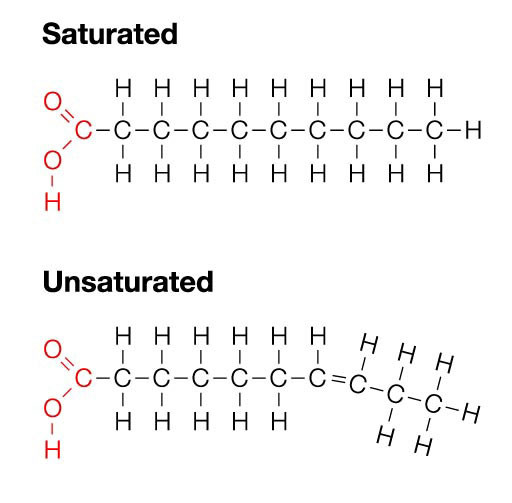
The difference between saturated and unsaturated fats lies in the bond structure. (See the diagram below.)
Saturated fats contain no double bonds. Each carbon (C) has two hydrogens (H). The chain is “saturated” with hydrogens. Because of this chemical configuration, saturated fats are generally solid at room temperature.
Unsaturated fats, on the other hand, have one or more double bonds between the carbons. Thus not all of the carbons have hydrogens stuck to them. This puts a “kink” in the chain.
Monounsaturated fats have one double bond and polyunsaturated fats have more than one.
These molecular shapes of various fats are important, because the shapes determine how the various fats act in the body.
What is a “healthy fat”?
In popular terminology, the monounsaturated and polyunsaturated fats are what most people refer to as “healthy fats.”
Yet humans have likely consumed unprocessed forms of saturated fats (such as organ meats from wild game, blubber from seals and whales, milk, or coconuts) for their entire existence.
Humans evolved on diets consisting of marine life, wild game and/or inland plants, which provided abundant omega-3 and other unprocessed fats.
Early humans (and many hunter-gatherer groups today) consumed all parts of animals — including fatty tissues such as blubber, organs, and brains along with eggs from fish, fowl, and reptiles.
So, a better definition of “healthy fat” might be “relatively unprocessed fats from whole foods”.
Unhealthy fats are typically those that are industrially produced and designed to be nonperishable, such as:
- trans- fatty acids that appear in processed foods
- hydrogenated fats such as margarine (hydrogen is added to the fat chain to make a normally liquid and perishable fat into a solid and shelf-stable fat)
- most shelf-stable cooking oils (e.g. safflower, soybean, corn oil, etc.)
Fats in balance
Since humans evolved by consuming a diet of whole foods, fat intake from mono-, poly-, and saturated sources was distributed evenly.
Scientists estimate that the omega-6/omega-3 ratio in a hunter-gatherer diet is around 1:1. Humans currently consume a ratio of about 16:1 to even 20:1 – an intake that’s way out of balance.
Much of our omega-6 and saturated fat intake is from refined fat sources, not from whole foods.
Items like corn oil, safflower oil, and factory-farmed meat/eggs/dairy contain unhealthy balances of fat. Soybean oil alone accounts for over 75% of oils consumed by Americans.
Why are healthy fats so important?
People are often concerned about excess dietary fat, but not getting enough “good” fats may also cause health problems.
A wide range of health effects
Fats exert powerful effects within the body.
We need adequate fat to support metabolism, cell signaling, the health of various body tissues, immunity, hormone production, and the absorption of many nutrients (such as vitamins A and D).
Having enough fat will also help keep you feeling full between meals.
Healthy fats have been shown to offer the following benefits.
Strong evidence
- Cardiovascular protection (though there is less evidence for protecting against heart failure)
- Improve body composition
- Alleviate depression
Average evidence
- Prevent cancers
- Preserve memory
- Preserve eye health
- Reduce incidence of aggressive behaviour
- Reduce ADHD and ADD symptoms
You’re a fathead… literally
Fat we consume is digested and either used for energy, stored in adipose (fat) tissue, or incorporated into other body tissues and organs.
Many of our body tissues are lipid (aka fat) based, including our brains and the fatty sheath that insulates our nervous systems. Our cell membranes are made of phospholipids, which means they’re fat-based too.
Thus, the fat we consume literally becomes part of our cells. It can powerfully influence how our cells communicate and interact.
For example, fat can affect signaling molecules that influence blood vessel constriction, inflammation, blood clotting, pain, airway constriction, etc. Since our brains are fat-based, changes in fat composition can affect transmission of nervous system impulses.
For this reason, balancing our fat intake can promote optimal functioning of our entire body. Therefore it’s important that we emphasize whole food fat sources in our diets, and supplement as necessary.
More on fat types
Omega-3s
The most important omega-3 fats are the following:
- ALA (alpha-linolenic acid)fca
- DHA (docosahexaenoic acid)
- EPA (eicosapentaenoic acid)
Our bodies mostly use DHA/EPA, and don’t convert ALA very well. Most plant-based sources (e.g. flax, hemp, and chia) are rich in ALA while marine animal sources (i.e. fish) and algae are rich in EPA and DHA.
Thus, blood levels of omega-3 fats are typically lower in plant-based eaters than in those who eat meat, so plant-based eaters should be particularly vigilant about proper fat intake.
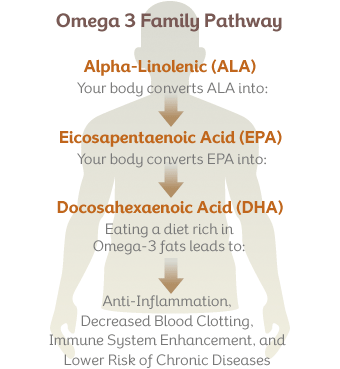
ALA conversion is particularly poor in people who consume a typical Western diet. Thus, people who eat diets high in processed foods and refined carbohydrates, etc. will not reap many benefits from ALA.
Get your EPA/DHA from marine sources. (See AA Algae for more on plant-based sources.)
Monounsaturated fats
Monounsaturated fats (e.g. from nuts, seeds, olives, and avocados) appear to lower LDL cholesterol (aka the “bad” cholesterol). They may also increase HDL cholesterol (aka the “good” cholesterol), but evidence for this is not as clear.
CLA
Once everything is in order with your nutrition and lifestyle, consuming CLA (conjugated linoleic acid) might be another option.
CLA resembles LA (linoleic acid) but the structure is slightly different, giving it a different effect in the body. It may help to control levels of body fat.
Food sources of CLA include pasture-raised/grass-fed animals/eggs. Plant-based CLA supplements are usually derived from sunflower oil.
Saturated fat
Saturated fat seems to support the enhancement of good cholesterol.
Fats from palm oil and coconut oil are highly saturated. Palm and coconut also contain medium chain fats, which can support health and optimal body composition.
Due to the high prevalence of animal foods and tropical oils (from processed foods) and the low prevalence of whole plant foods in the modern diet, people tend to get too much saturated fat relative to unsaturated fat, and combine these saturated fats with refined carbohydrates. Health suffers as a result.
In addition, tropical oils (e.g. palm and coconut oils) usually appear as industrially refined, hydrogenated fats in processed foods, rather than in their native form.
If you choose to consume these tropical oils, make sure they are unrefined (e.g. whole coconut or extra-virgin, cold-pressed coconut oil). For healthy saturated fats, look for pasture-raised meat and dairy.
Summary and recommendations
Get a mix of fat types from whole, unprocessed, high-quality foods. These include nuts, seeds (hemp, flax, and chia are especially nutritious), fish, seaweed, pasture-raised/grass-fed animals/eggs, olives, avocado, coconut, and cacao nibs.
Avoid industrially processed, artificially created, and factory farmed foods, which contain unhealthy fats.
Keep it simple. Don’t worry too much about exact percentages and grams.
Supplement with algae oil or fish oil daily. We recommend 1-2 g of algae oil or about 3-6 g of fish oil each day.
A few safety notes
If you:
- are taking blood thinners;
- have heart rhythm disturbances;
- are scheduled for surgery in the immediate future; and/or
- have any bleeding disorders
then check with your doctor and/or pharmacist before supplementing with additional omega-3s. However, it’s still generally safe for you to eat fish and seafood.
References
Click here to view the information sources referenced in this article.
Eat, move, and live…better.©
The health and fitness world can sometimes be a confusing place. But it doesn't have to be.
Let us help you make sense of it all with this free special report.
In it you'll learn the best eating, exercise, and lifestyle strategies – unique and personal – for you.



Share