Changing how you think is hard. Changing your environment isn’t. By training your environment, your habits follow. Here, 18 strategies from the experts. They’ll help you improve your lifestyle and transform your body, no willpower required.
++++
If I took 50 random strangers to the grocery store and asked them to fill their basket with only nutritious, health-promoting foods, I bet they could do it. In other words, most people generally know what’s “healthy.” Or good for them.
If that’s true, why are so many people sick from chronic preventable diseases? Why are they sedentary and carrying around extra body fat? Why are people not putting all those nutritious, health-promoting foods into their grocery baskets — or more importantly, their bodies?
Why are people eating so poorly?
Obviously, just knowing stuff isn’t enough to actually do stuff.
Being able to memorize carb grams, or calorie tables, or the names of exotic superfoods doesn’t often change what we eat when it’s time for a hurried breakfast or a got-home-late-from-work dinner.
Those particular eating decisions have more to do with what’s (and who’s) around us — our environment.
Save $200 on the industry's top nutrition certification
Help people improve their health and fitness—while making a great full-time or part-time living doing what you love.

Why is environment so important?
We like to think that we…think.
In other words, we assume we make rational, conscious, informed choices based on logically weighing all the available options. We assume that we make our decisions by thinking reasonably about things.
However, research has shown that most of our decisions are automatic, based on patterns and brain shortcuts.
Instead of slowly deciding, step by step, our brains quickly process a handful of grab-n-go inputs and pick from a recognizable menu of options. We ignore stuff we don’t like or want to see, and we’re easily compelled by shiny distractions.
Sound familiar?
Basically, our brains like the thinking version of fast food — go to the place that’s most appealing, speed through the drive-thru, pick the favorite combo from the menu, slam the decision, move on to the next choice.
So we don’t actually think much when we think we’re thinking.
We follow patterns, physical cues that bubble beneath our awareness, and what’s around us. That means our environment powerfully shapes our decisions, more than we realize.
For instance:
- Most of us will eat all that we’re served — no matter how big the portion is. If we’re served a small bag of popcorn, we’ll eat that. If we are served a bucket of popcorn, we’ll eat that. Presumably if we are served a Volkswagen full of popcorn, we’d do our best to finish that off too.
- We often eat more when we’re multitasking. Ever started snacking while watching TV or playing video games, then found yourself staring at an empty bag or bowl, wondering where it all went? Your attention was elsewhere, so your eating machine just went on autopilot.
- If we consistently eat bigger portions, bigger portions will seem “normal” — and we’ll regularly overeat. Our great-grandparents (who drank 7-ounce soft drinks and ate 4-ounce hamburgers in the 1950s) would be astounded at the 50-ounce Double Gulps and 12-ounce Monster Thickburgers commonplace in the US. We’ve lost our perspective on how much we should really be eating.
Our environment: The foundation of habit.
If you think of body change as a pyramid, here’s what it should look like.
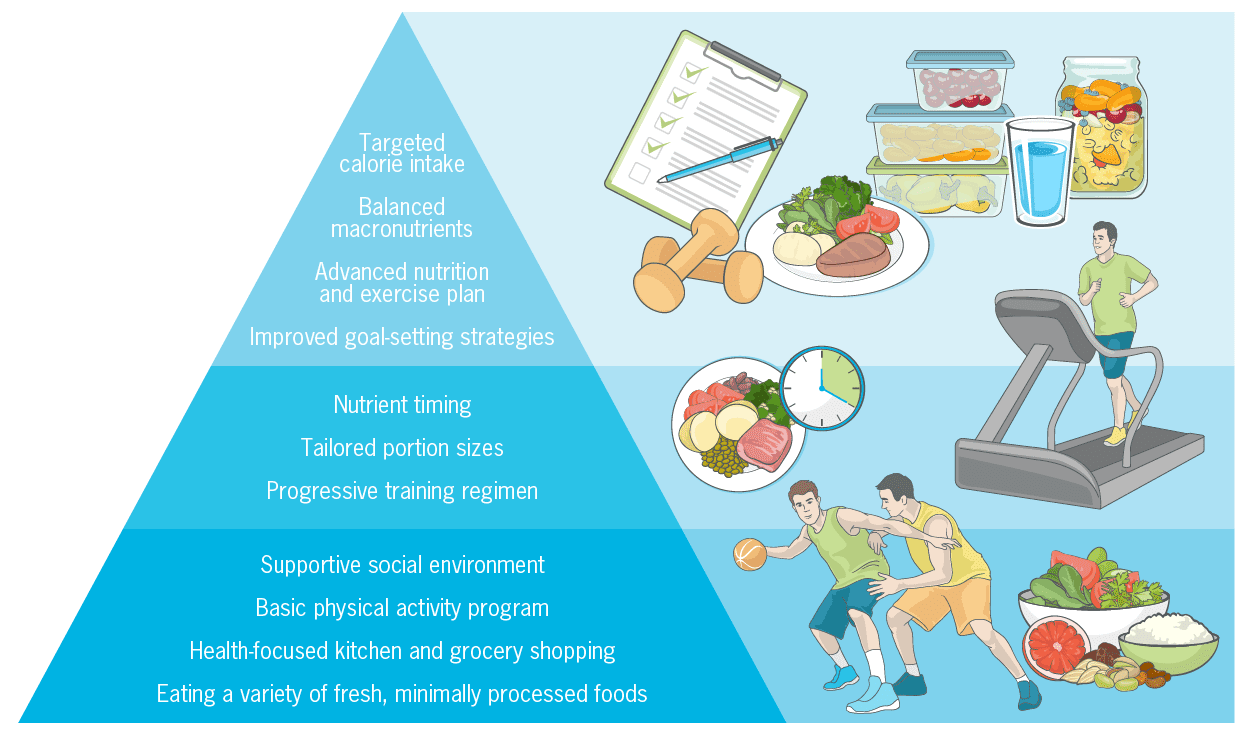
Notice: It’s the opposite of what you might expect.
All the “expert stuff” — adjusting macronutrients, advanced nutrition strategies, etc. — is at the top. You might not ever even get to it. It’s a “nice to have.”
The base of the pyramid — your foundation — is what surrounds you.
- Your social environment and culture.
- Your kitchen.
- Your grocery habits.
- Your day-to-day routine.
- Your peeps.
In general, when it comes to engineering healthy eating, here’s the golden rule:
- Make healthy behaviors convenient.
- Make other behaviors less convenient.
Some examples:
- Use smaller plates and cups. Most people eat everything on their plate. Use a smaller plate and you end up eating less naturally.
- If there’s a food you don’t want to eat, avoid keeping it around. Why risk the temptation? Make it less convenient to eat.
- Have fresh, healthy whole foods prepared and in plain sight. Veggies and fruits on your kitchen table or counter; that’s a good start.
- Park your car farther away from where you’re going so you have to walk. Those extra steps add up.
- Keep your bike ready to go by the front door. Instead of driving, consider biking.
- Get a dog that needs walking. Even better, one that will chew up your couch as punishment if you don’t take it for a daily spin around the block.
- Sign up for a CSA box. This way fresh, healthy produce and/or organic meat is delivered to you.
People often try to “work hard” to change their habits because changing how you think and feel is hard.
But why should everything be so hard, all the time? There’s no need to white-knuckle the willpower. You can actually make change much easier by simply changing your environment.
Harness your brain’s autopilot for the side of good:
By just changing what’s around you in small ways, you can make changes without even thinking about them.
Here are 18 awesome tips — collected from some of the most experienced nutrition coaches in the world — for changing your environment.
“Hard work” and “willpower” not required.
18 ingenious environment tweaks that will improve your eating habits immediately
1. Have an athlete-friendly meal delivery subscription.
Someone else will cook a meal that you know is healthy and bring it right to you.
What could be easier than that?
Pro tip: Look for a service that offers meals for athletes — they’ll offer double the lean protein (30-40 g) along with fibrous veggies like salad, steamed beans or broccoli.
2. Keep the ice cream, cookies, and chocolates out of the house.
Make “laziness” work for you by making it harder and more inconvenient to reach for high-calorie, low-nutrition, easy-to-overeat foods.
If you want sweets, you have to go get them. At 10 PM, when you’re snuggled into your sofa binge-watching your favorite TV show, it’s going to be a lot harder to motivate yourself to get up and go to the grocery store.
Pro tip: Keep a colorful assortment of dried and fresh fruits around for dessert instead.
3. Plan your meals.
Don’t make fresh decisions every day, or keep meal choices totally open-ended all the time.
Instead, take some time and make decisions in advance.
Pro tip: Every few days, sketch out the meals you’ll eat for the next few days. Check the list daily so you know:
- what to buy at the grocery store;
- what to pre-prep;
- what meal you’ll eat at what time (or when you’re really hungry).
4. Keep chopped, ready-to-eat vegetables in the fridge.
Put them front-and-center so you see them and can get to them easily.
Pro tip: To make your favorite salad veggies even easier, store them “restaurant style.” Clean and sterilize one of your refrigerator’s crispers, dump chopped veggies (loose) into it, and cover them with a damp paper towel and a couple of ice cubes.
5. Don’t be hungry and in the grocery store at the same time.
Treat grocery shopping like a surgical operation: Have a plan (like your meal list from Tip 3). Get in and get out efficiently. (See if you can make a game of it.)
Pro tip: Focus on the perimeter — the produce, meat, and dairy sections. Don’t even go down the processed food aisles, so you won’t be tempted.
Shop with a basket instead of a cart to limit what you can buy (it sneaks in an arm workout, too).
6. Keep shake-ready ingredients in the freezer.
Frozen chopped fruit can be dumped straight into the blender and will make your super shakes extra thick and cold.
Pro tip: Are there any greens in your fridge “on their way out”? Stick them in a gallon bag in your freezer. Once frozen, crush them to make flakes. This reduces the space they take up and makes them simple to add to shakes.
7. Keep a batch of cooked grains handy.
Whole grains take time to cook, but if you make a batch on Sunday, you’ll have it in the fridge to use in grain bowls and stir-fries all week long.
Pro tip: Make two batches, and portion one out by the cupful to keep in containers in the freezer. Brown rice reheats nicely in the microwave. It’s like having home-made minute rice on hand.
8. Help your kitchen coach you.
Keep your kitchen as clean, pleasant and clutter-free as possible so you feel relaxed when you enter it (stress = cookie binges). Have an edible plant (like sunflower sprouts) growing on the counter for when you feel like snacking.
Pro tip: Make the fridge door a “vision board” with post-it notes reminding you of your goals, inspiring pictures, and cool looking magnets.
9. Just put on your sneakers.
Having them on your feet often just makes you feel like getting active.
Pro tip: For that matter, consider just wearing comfortable shoes all the time, so you’re up for anything.
10. Keep workout gear in your face.
Have a kettlebell, resistance bands, a dumbbell or two, a pull-up bar, and/or a suspension trainer in your home or office so you’re more tempted to use them.
Pro tip: Do “trigger training”: Leave the gear in various places throughout your house, and whenever you pass one of them, do a few reps. Over the day this adds up quickly without eating up too much time or leaving you wiped out.
11. Pack your “mobile gym” when you travel.
Book hotels with gyms and/or pools. Toss a jump rope or resistance bands into your suitcase along with a list of bodyweight-only exercises (like squats and pushups) that you can do anywhere.
Pro tip: A kayak bag (20 L capacity) folds up small enough to fit in a carry-on but turns into a ~40 lb kettlebell once you fill it with water.
12. Turn your car into a locker room.
If you drive a lot, be prepared with gym clothes and a healthy snack so you don’t make counterproductive decisions in desperate moments. Keep a shaker bottle with measured protein powder and greens under the seat — just add water.
Pro tip: Keep a container of several changes of exercise clothes, shoes, and towels in your trunk so you’re ready to move no matter where the day takes you.
13. Schedule workouts like you schedule meetings.
Put them on your calendar and treat them like any other appointment.
Pro tip: Put everything from workouts, to laundry, to work meetings, to rest and recovery on your calendar so that very few things are “unexpected.” Most of our routines are pretty predictable.
14. Move social gatherings to parks and gyms.
It doesn’t always have to be a bar or restaurant. Make your next date outside (frisbee?) or at a climbing gym or trampoline park.
Pro tip: This goes for professional networking, too. Instead of sitting down at a coffee shop, get coffee to go and have a walking meeting.
15. Have only half a car (or less).
Sharing a car with your partner or a friend means you’ll have to walk or bike more (some Precision Nutrition staffers have invested in cargo bikes so they can cart their kids along with them).
Pro tip: Walk on errands, even if your destination is on the outside edge of “reasonable.” For example, instead of driving seven minutes to the post office (or asking your partner to do it), take 25 minutes to walk there. That’s 50 minutes walking rather than 15 minutes sitting in the car, but the errand only took an additional 35 minutes from your day.
16. Combine walking and working.
Moving while you brainstorm or take a work call helps you focus and avoid the I-sat-at-a-desk-all-day soreness.
Pro tip: Get a used treadmill for a couple hundred bucks off Craigslist and fit it with a SurfShelf for your laptop. Now you can write, edit, fire off emails…all of it while you walk.
17. Separate yourself from your work once per hour.
Work for 50 minutes, then step away from your desk for 10 (may we suggest a walk, some stretches, or some squats?). Cycle this for your workday. You’ll find that you still have energy and focus by the end.
Pro tip: Install anti-RSI software, which “locks” your computer for 5-10 minute intervals every hour so you’re forced to give work a rest.
18. Turn family and friends into coaches.
To create a supportive environment, be explicit with loved ones that you’re trying to eat better and get fit — and why. They don’t have to participate, but ask them to help. That takes the pressure off them to do what you’re doing, and most people (especially kids) like “helping” in some way. (Kids love to nag, so hire them as your alarm clock and workout reminder.)
Pro tip: Involve your family in goal-related activities, such as menu planning, meal prep, and rep counting. This reduces resistance by giving them ownership, meaning you won’t feel you’re the “other.”
If you’re a coach, or you want to be…
You can help people build sustainable nutrition and lifestyle habits that will significantly improve their physical and mental health—while you make a great living doing what you love. We'll show you how.
If you’d like to learn more, consider the PN Level 1 Nutrition Coaching Certification. (You can enroll now at a big discount.)
Share