
In case you haven’t heard, sleep is absolutely crucial to your health. With a few simple strategies, you can get the high-quality, restful sleep your body and your mind deserves.
- Want to see our visual guide? Check out the infographic here…
++++
Introduction
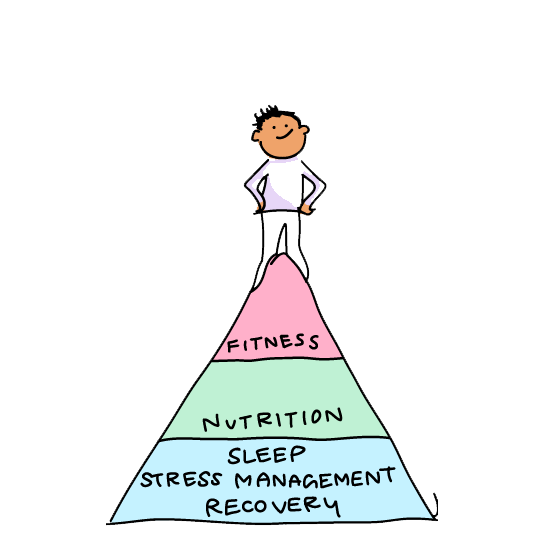
Sleep is just as important as nutrition and exercise when it comes to improving your health, performance, and body composition.
Good sleep helps our bodies and minds recover, keeping us lean, happy, mentally focused, and healthy.
But chronically bad sleep:
- makes it harder to get and stay lean;
- makes it harder to gain and keep muscle and other lean mass;
- disrupts hormones;
- ages us faster;
- increases our risk of chronic illness;
- drains our IQ; and
- kills our mojo.
(For more on this, see All About Sleep.)
Fortunately, research also shows that returning to adequate sleep can quickly reduce these risks.
So how do we go about getting that replenishing shut-eye?
Become one of the first coaches to specialize in Sleep, Stress Management, and Recovery.
When clients are stressed, overwhelmed, and exhausted, eating better and exercising more can be nearly impossible. But you can become the rare professional who can help clients break through these obstacles—and help them thrive.
Join the waitlist to get our biggest discount when registration opens + get our free Enrollment Packet today.
Create a sleep routine
Just like you can’t go from 0 to 100 first thing in the morning, you can’t do the reverse at night — going from “on” to “off” in a few minutes. Your body needs transition time and environmental cues to wind down.
Thus, the first step to getting more and better sleep is to create a nighttime routine that tells your body that you are preparing to go to sleep. Over time, if you’re consistent, your body will start the process of gearing down automatically.
Keep a regular schedule.
Our bodies like regularity. Try to go to bed and wake up at the same time every day and night. While it might be unrealistic to do this seven days a week — especially if you have young children, like I do — try to be as consistent as possible.
If you’re consistent, your body will know when to release calming hormones before bed, and stimulating hormones to help you wake up. You’ll feel sleepy when it’s time for bed and wake up more refreshed, often without needing an alarm.
Keep alcohol and caffeine moderate.
Genuinely restful and restorative sleep comes from deep sleep.
Even though it seems like booze is relaxing, more than 1-2 drinks in the evening can interfere with deep sleep, as can too much caffeine.
So limit alcohol to the suggested amounts, and reduce caffeine after 2 pm.
Otherwise, although you may “sleep” for 7 hours, your sleep won’t be high quality, and you won’t get the recovery benefits.
Eat and drink appropriately.
Having a large meal immediately before bed can disrupt your ability to fall and stay asleep. Instead, eat a regular-sized (or even smallish) meal a few hours before bedtime.
A nice blend of protein, carbs and fats will help to keep you satiated, and might even improve your ability to fall asleep as your brain converts carbs to serotonin.
In addition, try to limit your fluids 2-3 hours before bedtime. Drinking too much liquid shortly before bed can result in frequent waking for bathroom breaks.
While total sleep time is important, uninterrupted sleep time is even better.
Do a brain dump.
We’ve all done it: Stared at the ceiling, long after lights-out, obsessing about all the things we’re supposed to do tomorrow, tossing and turning and getting more and more stressed by the minute.
Try this instead: In the evening, take a few minutes to write out a list of whatever’s bugging you: Emails you need to send or reply to, calls you have to make, project ideas, creative thoughts, that thing you should have said to so-and-so…
Whatever is in your brain, get it out and on to paper.
Around here we call this a “brain dump.” It clears your mind for genuine relaxation.
Turn off electronics.
Digital devices stimulate our brain with their light, noise, and mental demands.
Unplug from all screens — TVs, computers, phones, tablets — at least 30 minutes before bed.
(If you must read your tablet, switch the screen to the black or dimmer background. And if you’re going to be on your computer, download a program like f.lux, which decreases your screen’s color temperature at night.)
Our brain produces melatonin as light levels decrease. Melatonin ensures deep sleep, and may also help regulate our metabolism. If we have too much light at night, we don’t get proper melatonin production.
Stretch / read / de-stress before bed.
What de-stresses you? Do that.
This could include:
- Gentle movement — such as stretching or yoga, or even a slow stroll around the block. Even 5-15 minutes can release tension and activate calm-down chemicals.
- Reading before bed — but make sure it’s not too engaging — otherwise you’ll be tempted to stay up with that thrilling detective novel until the wee hours.
- Meditation, deep breathing, or other simple relaxation exercises
Go to bed before midnight.
Interesting factoid: According to some sleep experts, because of the way our natural circadian rhythms work, every hour of sleep before midnight is worth two hours after.
(Whether that’s true or not, or whether it’s even measurable, I’m not sure. But I’ve heard it repeated so often by sleep experts it’s probably worth consideration.)
According to these experts, we’re meant to go to sleep when it gets dark, and to wake when it gets light. That old saying about early to bed and early to rise still stands the test of time.
Sleep at least seven hours.
Most people need 7-9 hours of sleep per night. 7 should be your baseline.
If you know you have to wake at 5:15 to get ready for work, then you should be in bed by 9:30 and asleep by 10. Getting in bed at 10:15 doesn’t count.
Also factor in transition time. Don’t stop what you’re doing at 9:29 and expect to be snoring by 9:30. Start moving in the direction of bed by 9:00.
Yes, we know. There’s this whole movement, started by time-starved Silicon Valley executives, where folks try to “hack” their sleep and get away with much less.
And, sure, it can work for a while. But every piece of credible research demonstrates that you pay a big health (and productivity) price for consistently getting less than 7-9 hours.
Exercise regularly.
Exercising regularly helps normalize circadian rhythms, tone down the sympathetic nervous system, and regulate endocrine function.
However, save the intense exercise for during the day if possible — a weights or interval workout in the evening can rev us up and make it tougher to get to sleep.
Take a bath or shower.
While not everyone likes to shower or bathe at night, warm water before bed can help us relax and de-stress, which is key for falling asleep. If you go the warm water route, throw in some magnesium-based epsom salts as magnesium is known to help with sleep.
Some brave souls — including JB — swear by cold water in the evening. The logic is that cold water stimulates a strong parasympathetic nervous system response once the initial shock has passed. A short, very cold shower will do the trick.
Give it a try, and see which works better for you.
Optimizing your sleep environment
In addition to creating a nightly sleep routine, to help improve your sleep quality and duration, you should ensure that your sleeping environment is actually conducive to sleep.
A few small adjustments can make a big difference here.
Keep the room as dark as possible.
Melatonin is a hormone produced by your brain that signals to your body it is time for sleep. Making your room as dark as possible will maximize your melatonin production.
Meanwhile, light — particularly blue light, which most electronics produce — inhibits melatonin production and makes it harder to fall and stay asleep. (Sunsets produce red light.)
So how can you limit light exposure?
- Dim lights at night. Install low-wattage bulbs in your bedroom, and keep things as dim as possible in the hour before your planned bedtime.
- Cover your windows well. (Maybe time to upgrade from the cruddy IKEA Venetian blinds you’ve had since undergrad?)
- Use a motion-sensitive or dim night light if you need something to illuminate your midnight path to the bathroom.
- Put your iPhone in another room or flip it face down.
- Cover or dim the alarm clock, or look for one that illuminates only when touched.
- Again, if you have to use a computer late at night, download the software f.lux, which changes the brightness and tone of your screen in time with sunset and sunrise, reducing evening blue light.
Create a relaxing sleep area that is quiet and free of clutter.
Your bedroom should be relatively organized and peaceful.
The sight of clothes strewn all over the floor or furniture, boxes or books toppling over, and tangled cords can make you feel stressed and interfere with your ability to relax.
A messy room can also be dangerous if you have to get up at night to use the bathroom.
Set your room to an appropriate temperature.
Most people sleep better when it’s cool (around 67 F); others sleep better at a neutral temperature.
Find what works best for you and do your best to regulate your bedroom to that temperature each night.
Use white noise if needed.
If you live in an urban environment and you tend to pop awake at the slightest sound, then a steady source of white noise could really help.
Using some nature sounds on your iPhone, or even just turning on a fan (or an old radio to static) can be enough to drown out other noises and lull you to sleep.
A HEPA filter can also work well for this purpose, serving double duty by keeping your air cleaner as well.
How to wake up
Think of sleep as something that begins the moment you wake up. In other words, what you do during the day will affect what happens that night.
So let’s look at how to wake up.
While a jarring alarm will certainly get us out of bed, it doesn’t exactly start the day on an enjoyable note. Not only that, it jacks up our stress hormones immediately, starting our day in “fight or flight” mode.
Here are some more humane solutions.
Take advantage of natural rhythms.
Sleep occurs in multiple stages, alternating between deeper and lighter sleep. We sleep more and more lightly as the night goes on.
If we wake up at just the right moment in our lighter sleep stages, we’ll feel reasonably good and snap into alertness quickly.
But if we’re forced to wake up while in a deep sleep phase, we’ll feel groggy, disoriented, and sleepy — suffering from sleep inertia.
There are many gadgets and apps that will sense your sleep cycles and wake you up when you’re sleeping your lightest.
You can also track your sleep with gadgets and apps like Zeo or the Fitbit, which will help you gauge where to improve your sleep and wake routines.
Wake up to light.
The human body is designed to get sleepy when it’s dark and to wake when it is light.
However, it is not always feasible to wake up with the sun, and this is especially true if you use light blocking shades to keep your room as dark as possible.
Solution: Use a dawn-simulating alarm clock.
Research shows that when people are slowly roused by gradually increasing light levels, they feel much more alert and relaxed than when they’re woken up by a sudden, blaring alarm.
I personally use and love my Biobrite, as it slowly lights up my room, reaching maximum brightness at my wake time.
Increasing light has also been shown to raise cortisol in the morning (which is an important signal to your body to wake up), and to improve sleep quality. It can even decrease depressive symptoms in seasonal affective disorders.
Wake up to soft, slowly building noise.
Some types of alarm clocks (such as the Progressive Alarm Clock app) will also gradually increase noise or music, so that you’re slowly lifted out of sleep rather than being suddenly whacked in the ear with a loud morning DJ.
Get moving right away.
While I don’t have any research to support this argument, I believe it helps to put your feet on the floor the minute you wake up. It’s a recommendation I borrowed from Mike Boyle, and it’s worked tremendously well for my clients and me.
When your alarm goes off, one of the worst things you can do is hit snooze. Snoozing seems to increase sleep inertia.
Instead, once that alarm goes off, simply sit up and put your feet on the floor. Start shambling towards the bathroom, or anywhere else that isn’t your bed.
There is something magical about movement that seems to speed up the waking process.
Expose yourself to more light.
Whether you wake to a dawn-simulating alarm clock or not, continue to expose yourself to light as soon as possible after waking. This will stop melatonin production and increase your wakefulness.
Throughout the day, get as much light as you can. Most folks can sneak outside for 5-10 minutes. Run errands at lunch or eat outside. Do as much as you can to get that sunshine.
The more bright natural light you can get during your normal waking time, the more your body will know to gear down at your normal sleeping time.
(If getting natural light isn’t an option, you could always go with a device like Litebook Elite.)
Conclusions
Good sleep is crucial for good health. There are no short cuts, despite what the “sleep hackers” say.
Make good sleep a priority. Your physical, mental, and emotional wellbeing will thank you.
Think about good sleep as a 24-hour process. What you do during your waking period will affect your sleeping period, and vice versa.
Reinforce your natural circadian needs. When it’s supposed to be dark and quiet, make things really dark and quiet. When it’s supposed to be bright, noisy, and stimulating, get moving with some bright light.
Give your body and mind transition time. Allow at least 30 minutes (and preferably an hour) in the evening to slowly wind down and prepare for sleep.
Stick to a routine. Bodies love routines and consistency. If your body knows what to expect in your day, it’ll help you wake up and doze off at the right time.
You can’t control your actual sleep. But you can control your sleep behaviors and environment. Take charge of your actions and surroundings, be consistent, and enjoy the Zs.
References
Click here to view the information sources referenced in this article.
If you’re a health and fitness pro…
When your clients are stressed and exhausted, everything else becomes a struggle: going to the gym, choosing healthy foods, and managing cravings.
But with the right tools, you can help your clients overcome obstacles like stress and sleep deprivation—leading them toward the lasting health transformations they’ve always wanted.
PN’s Level 1 Sleep, Stress Management, and Recovery Coaching Certification will give you these tools. And it’ll give you confidence and credibility as a specialized coach who can solve the biggest problems blocking any clients’ progress.
Share