What is environmental eating?
Environmental eating is something we feel strongly about here at PN. We want to do our best to be mindful of the resources at our disposal and to prioritize conservation.
In plain English, environmental eating means realizing that we have a limited supply of resources such as fossil fuels, farmland, clean water and food. It also means that we think about these finite resources when we choose how to eat.
How do our food choices impact these resources? Well, read on.
Why is environmental eating so important?
With an increasing population, the struggle for scarce resources such as fossil fuels, arable land, clean water and food is intensifying. People are increasingly concerned about “sustainability” – our long-term ability to meet our current needs without compromising the wellbeing and resources of future generations.
Let’s consider these resources. Keep in mind that we’re simply presenting information. We’re not drawing conclusions just yet. We don’t want to tell you how to think. We simply want you to read with an open mind and consider what’s right for you.
Resource #1: Fossil fuels
To produce food and get it to the consumer requires energy for processing, packaging, and distribution. Where do we get this energy? Typically from fossil fuels such as oil and gasoline. Our massive oil consumption has an impact on gas prices (after all, if we didn’t need it, then it wouldn’t be very valuable). And the food industry, especially the American food industry, is a huge consumer of oil.
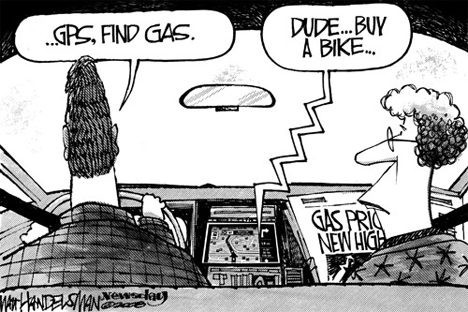
Many people don’t realize how much fossil fuel is actually required in the entire food production chain:
- Oil refined for gasoline and diesel runs the farm vehicles and equipment that plant the crops, spray the herbicides/pesticides on the crops, and harvest/transport the seeds and the eventual harvest. (For an example of one farm that’s doing things differently, check out OilSeedWorks – they run their entire farm, including machinery and heating, on industrial hemp power. Even their farm house is built out of hemp bales!)
- The vitamins and minerals, emulsifiers, preservatives, colouring agents, etc are produced using oil-based energy sources. They’re also shipped between factories, again using gasoline.
- Many of the items used in food production, including boxes, metal cans, printed paper labels, plastic trays, cellophane for microwave/convenience foods, glass jars, plastic and metal lids with sealing compounds are oil-based.
- Delivery of food is oil-based too. The finished food products are moved to distribution centers in refrigerated trucks. Regular, “just-in-time” shipments of food to grocery stores, restaurants, hospitals, schools, etc., are all oil-based. Then the customer drives to the grocery store to shop.
- Exporting and importing foods is becoming commonplace. The average food item travels 1200-2480 miles (about 2000-4000 km) in the US, all by fossil fuel-powered methods, before it reaches the kitchen table.
Interestingly, when you add up all the fossil fuel that goes into growing our food and getting it to our bodies, it ends up being quite a lot, especially if you live in the US. In fact, in the US about 20% of all the fossil fuels consumed are by the food industry!
To put this into perspective, it’s been estimated that if the rest of the world adopted US-style agricultural production methods, the global oil supply would be dry in roughly 12 years. Of course, it’s not likely that this would ever happen. However, it’s a pretty sobering statistic nonetheless.
On the flip side of the coin, there are ways to get better control of our fossil fuel consumption. For starters, if we choose locally grown foods more often, the fossil fuel cost of every post-harvest process can be reduced.
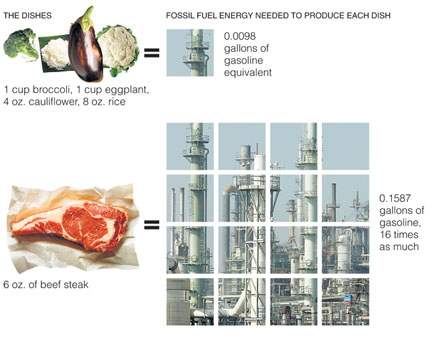
Also, dietary protein choices can make a significant difference in the amount of fossil fuel energy consumed. Check out these estimates. For every 1 unit of protein they provide:
- Grain & bean proteins require 2 units of fossil fuel energy
- A broiler chicken requires 4 units
- Milk & pork require 14 units
- Eggs require 39 units
- Beef requires 40 units
- Lamb requires 57 units
If animal proteins are produced from animals fed only on high-quality pasture lands, organically, and not in factory farms, the energy inputs can be reduced by about half.
Resource #2: Land (and air)
In order to eat a rich, diverse diet, we need land. You know, to grow the plants and to raise the animals. Unfortunately, land is becoming a scarce resource.
For starters, we’re filling landfills at an alarming rate. With the population growing and the abundance of packaged foods (and other items), food boxes and cans, wrappers from bars, empty water bottles, empty soda cans, disposable cups, etc. are becoming ubiquitous. And they’ve gotta go somewhere. So we bury them, reducing the amount of land we can farm and/or raise livestock on.
Beyond this, conventional farming often leads to the loss of topsoil. As a result, about 90% of US cropland loses soil quickly – some estimate the losses are 13 times above the sustainable rate (per year). So why is this a problem? Well, at a certain point, when enough topsoil is lost, you can’t grow crops. There’s less land to farm and/or raise livestock on.
In addition, in land terms, our livestock cost us a hefty price. Factory farms that produce meat require ever-increasing amounts of corn, soy and other grains. So it’s not just the land we use to raise the animals, but the land we use to grow crops that feed the animals. It’s been estimated that meat production takes 6 to 17 times more land than plant protein production does.
Resource #3: Water
Surface water in rivers, lakes and groundwater provide the fresh water supply for the world. This includes the water you drink, the water you cook with, the water you shower with, etc. And there isn’t an infinite amount of this water.
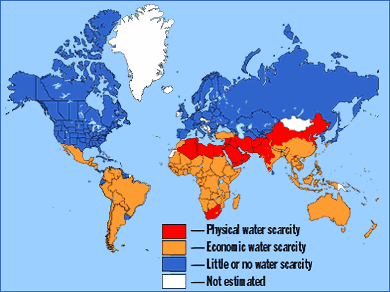
Sure, groundwater resources are renewed at various rates. However, this renewal is slow, much slower than the rate at which we use it. For this reason, about 80 nations in the world are already experiencing significant water shortages.
In China, more than 300 cities are short of water and the problem is escalating. By 2025, over 3 billion people are likely to be experiencing “water stress” and 14 additional countries could be classified as water-scarce. That’s no good.
Agricultural production, including livestock production, uses more fresh water than any other human activity. Worldwide, about 82 percent of the fresh water is used by agriculture! And the most costly water consumers are our livestock.
To put this into perspective, a standard American diet (with food being produced in the US) requires about 4,200 gallons of water per day to produce it. Contrast this with the fact that a standard plant-based diet (with food being produced in the US) requires about 300 gallons of water per day. Even drinking pop is a drain on water reserves. Producing 1 liter of pop requires approximately 2.5 liters of water.
And taking fewer showers isn’t the answer. A 6 minute shower uses 15 gallons of water, or 105 gallons per week. Not showering for 5 months would conserve only about 2100 gallons of water – and leave you dateless on Saturday nights.
Of course, every little bit helps. But experts think that dietary choices can make a big difference in our own personal water consumption.
Resource #4: Food
Most of our food, at its source, comes from either plants or animals, including fish. And even this food is becoming scarce in some parts of the world.
For example, global fishing yields have declined by 10.6 million metric tons since 1994. The UN estimates that more than 2/3 of the world’s fish species are either depleted or fully exploited. A study from 2006 found that if current overfishing and pollution patterns continue, we can expect to see a complete collapse of world fish populations by 2048.
“Unless we fundamentally change the way we manage all the oceans species together, as working ecosystems, then this century is the last century of wild seafood.” –Marine biologist Stephen Palumbi, Stanford University
In addition to fish, a lot of the plants we grow are used to feed our livestock. In the US the livestock population consumes more than 7 times as much grain as is consumed directly by the entire American population. If this grain was diverted to human consumption, we could feed more people. Indeed, when 2.5 acres of land is used to produce potatoes or cabbage, the energy needs of about 22 people can be met. When 2.5 acres of land is used to produce beef or eggs, the energy needs of about 1 person can be met.
What you should know
While environmental eating has been in the spotlight over the past few years, studies have shown that when consumers don’t think much about the environment when they buy their food and drink.
One study found that a small minority of environmentally conscious consumers actively consider issues such as seasonality and supporting local farmers. But even these consumers aren’t driven by a desire to support sustainable living – they just like the taste of fresh food better.
We think about several things when we decide to buy food. Most often, we think about convenience, cost, health, habits, taste and availability. The addition of sustainability and environmental impact to that list may take some time. Fortunately, many of the healthier food options can simultaneously benefit the environment. Organic, local, and seasonal foods are healthier, taste better and have less packaging than their counterparts.
While the general public often assumes that environmentally conscious behavior involves higher cost and poorer quality, the opposite tends to be true. Farmer’s market food tends to be 30 – 40% cheaper than food at grocery stores.
For extra credit
If you’re interested in learning more:
- Video Presentation – What’s Wrong With What We Eat?
- Video Presentation – Environmental Eating
- Video Clips: Mad Cowboy Part 1, Mad Cowboy Part 2
Summary and recommendations
As you digest the information from this article, we think it’s important to remind you that environmental eating is not an “all-or-nothing” thing. Just because we can’t do everything doesn’t mean we shouldn’t do something.
Next week we’ll look at Part 2 of this All About Environmental Eating series, and consider ways that you can make small changes in your own eating habits.
References
Click here to view the information sources referenced in this article.
Learn more
Want to get in the best shape of your life, and stay that way for good? Check out the following 5-day body transformation courses.
The best part? They're totally free.
To check out the free courses, just click one of the links below.



Share